
You’ve probably said it without thinking twice.Someone asks you to grab coffee, and your schedule’s a mess, so you say, “Can I take a rain check?”It’s one of those phrases that feels natural in English, but its backstory is way more interesting than you’d guess.This guide breaks down the rain check meaning, where it came from, and how to use it right, whether you’re texting a friend or turning down a work lunch.
We’ll also cover the version most people forget about, the retail rain check, and the honest mistakes people make with this little phrase.
Rain Check Meaning
At its core, a rain check is a polite way to postpone plans.
You use it when you can’t do something right now, but you still want to do it later.
Say your friend invites you to a movie, but you’re swamped with work.
You’d say, “I’ll take a rain check,” which tells them you’re interested, just not today.
Quick Answer
A rain check means you want to postpone something without saying no to it forever.
You’re not canceling plans, you’re just asking for another time.
The phrase started with baseball, but people now use it in dating, work, and even shopping.
The Shopping Meaning

Here’s where it gets a bit more literal.
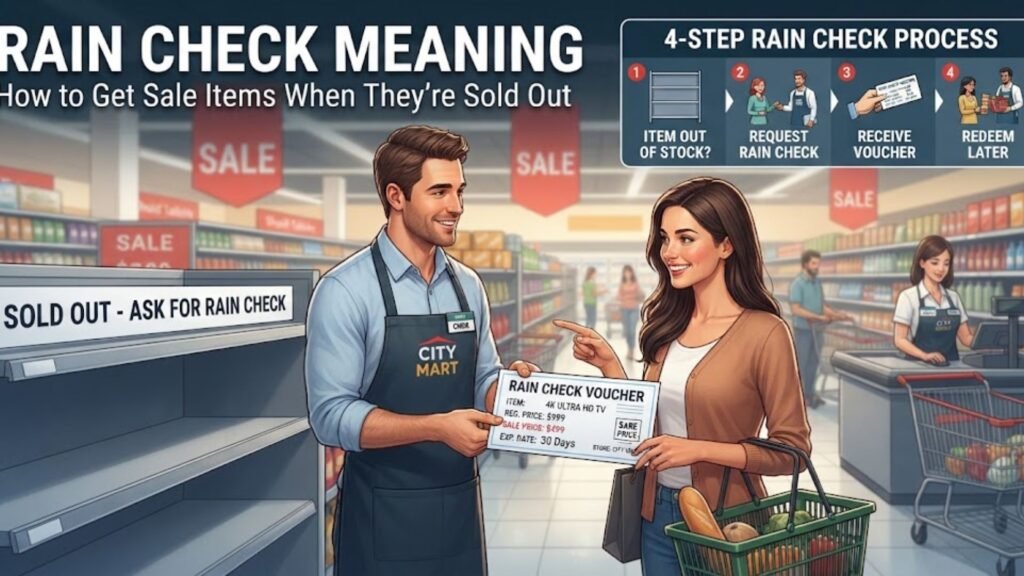
In retail, a rain check is an actual document a store gives you.
If an advertised sale price item is out of stock, the store promises you can still buy it later at that same discounted price.
So a customer walks away with a paper (or digital) note instead of the product, and cashes it in once the item’s back on shelves.
Rain Check Meaning Table
| Context | What It Means | Example |
| Casual conversation | Postponing a hangout | “Rain check on dinner tonight?” |
| Dating | Delaying a date without losing interest | “Can we take a rain check on our date?” |
| Workplace | Rescheduling a meeting or lunch | “I need a rain check on our 1-on-1.” |
| Retail | A slip promising a sale price later | “The store gave me a rain check for the TV.” |
| Texting | Quick, casual way to reschedule | “Rain check? Swamped today.” |
Where Did the Phrase Rain Check Come From?
The origin goes back to American baseball in the 1800s.
When outdoor sporting events got rained out, spectators didn’t just lose their money.
Instead, they’d get a replacement ticket they could use to attend another game later, because nobody wanted a soggy afternoon to ruin business.
That little paper ticket eventually gave us the phrase we use today for any kind of delay.
By the early 1900s, the idea had jumped beyond the ballpark and into everyday casual conversation.
People started applying it to social plans, not just postponed games, and it stuck around because it’s such a clean way to say “not now, but soon.”
How to Use Rain Check in Everyday Conversation
Using this English idiom correctly comes down to intent.
You say it when you genuinely want to meet later, not as a soft way to decline for now and never follow up.
Informal Examples
- “Rain check on tonight? I’m exhausted.”
- “Let’s take a rain check on the hike, it’s freezing.”
- “Can I get a rain check on movie night?”
Professional Examples
- “I’ll need to take a rain check on our meeting today.”
- “Can we schedule another time for the project review?”
- “I have a deadline, so let’s reschedule the business lunch.”
Example Sentences
A few more, so you get the rhythm of it:
- “She took a rain check on the party since she caught a cold.”
- “We’ll do coffee another day, I promise, just a quick rain check.”
- “He asked for a rain check on the date because of a family visit.”
Notice how none of these sound like a rejection. That’s the whole point of this phrase construction.
Common Situations Where People Say Rain Check
Friends
Friends use this phrase constantly for casual outings like dinner, a study session, or a spontaneous movie night.
Nobody takes offense, because everyone understands the unwritten rule: a rain check just means “soon, not now.”
Dating
In dating, a rain check on a dinner date can feel nerve wracking to ask for.
But if the interest is real, it actually shows respect, since you’re being upfront instead of ghosting or making an excuse that goes nowhere.
Workplace
Workplace communication often needs this phrase when a deadline or unexpected task eats into your day.
Saying “I’ll take a rain check on our meeting” sounds far more professional than just no-showing or canceling without a reason.
Shopping
And of course, there’s the original retail use, where stores hand out a physical or digital promise for a sale item they’ve run out of.
Similar Phrases
If “rain check” feels overused, try one of these instead:
- “Let’s reschedule”
- “Maybe another time”
- “Can we set a new date?”
- “Catch up later?”
- “Not today, but soon”
These work well in both formal and informal usage, depending on tone.
When Not to Use Rain Check
This phrase isn’t built for every situation, and using it wrong can send the wrong signal.
Skip it for serious business decisions, like turning down a job offer or a contract, because it sounds too casual for that weight.
It also doesn’t work well when you’re politely declining something permanently. Saying “rain check” implies you’ll circle back, so don’t use it if you have zero plans to follow through.
Rain Check in Text Messages
Texting is honestly where this phrase thrives the most these days.
It’s short, it’s friendly, and it doesn’t require a paragraph of explanation.
A quick “rain check?” with a question mark gets the message across instantly, and most people reply with an easy “no worries.”
Social media conversations and group chats use it the same way, often paired with an emoji to keep things light.
Rain Check Across Cultures and Countries
Interestingly, this English expression doesn’t translate word for word into most other languages.
Countries with strong baseball or cricket cultures sometimes have their own version tied to weather delays, but the casual social use is largely an American English habit that’s spread through movies, shows, and global business English.
If you’re chatting with a non native English speaker, it’s worth explaining the phrase briefly before using it, since the idiom meaning isn’t always obvious from the words alone.
Rain Check in Movies, TV, and Pop Culture
You’ve heard this line in sitcoms more times than you can count.
Characters use it to dodge awkward invitations, delay dates, or buy time before a big decision, and it always lands because audiences instantly get the interpretation without needing subtitles.
That constant exposure through pop culture is a big reason the phrase feels so natural in daily conversation today.
Rain Check Etiquette: How Many Times Is Too Many?
Here’s something the outline doesn’t always cover, but it matters a lot.
Asking for one rain check is normal. Asking for three in a row on the same invitation starts to feel like a polite response wearing thin, and the other person will notice.
A good rule of thumb: if you’re taking a rain check, try to suggest a rough timing for another time, even if it’s loose. “Rain check, but let’s aim for next week?” lands much better than a vague “rain check” with no follow up in sight.
This small habit is what separates a considerate communication style from one that quietly frustrates people. Nobody minds a delay. What frustrates people is silence after the delay, since it makes the invitation feel forgotten rather than postponed.
Rain Check vs Actually Canceling
It helps to draw a clear line between these two, since people mix them up constantly.
Canceling plans means the plan is dead. There’s no expectation of a redo, and both sides move on without needing closure.
A rain check, on the other hand, keeps the door open. You’re signaling continued interest and an intention to reschedule, not just backing out quietly.
The confusion usually happens when someone says “rain check” but actually means “I’m not coming, ever.” That mismatch between words and intention is where false expectations creep in, and it’s honestly one of the more common social frustrations tied to this phrase.
Common Mistakes
Thinking It Means No Forever
A rain check is not a rejection. It’s a future opportunity, not a permanent close.
Using It Without Intending to Meet Later
If you never plan to follow up, don’t say it. This creates false expectations and can damage trust in personal relationships.
Confusing It With Bad Weather
Despite the name, the phrase rarely has anything to do with actual rain or weather conditions anymore.
Assuming Every Store Offers Rain Checks
Not every retail policy includes rain checks, especially for limited-time promotion items or online sales. Always ask the store directly.
Why People Like This Expression
People gravitate toward this phrase because it’s gentle.
It shows flexibility, respect, and genuine appreciation for the invitation, all while keeping the door open for future plans.
Instead of an awkward “no,” you get a warm “not yet,” and that small shift in wording keeps relationships smooth and drama free.
Conclusion
A rain check is one of those small phrases that carries a lot of social weight.Whether you’re rescheduling a meeting, delaying a date, or grabbing an item on sale later, it’s a simple, honest way to say “I still want this, just not right now.”
Use it with real intention, and it’ll keep your friendships, dates, and work relationships running smoothly.
FAQs
What does rain check mean?
It means postponing plans to a later time without canceling them completely.
Is rain check an idiom?
Yes, it’s a well known English idiom rooted in baseball history.
Can I use rain check in a text message?
Absolutely, it’s actually one of the most common ways people use it today.
Does rain check always involve rain?
No, the weather connection is mostly historical now. It rarely relates to actual rain in modern use.
What does taking a rain check mean in dating?
It means delaying a date while still showing genuine interest in meeting up later.
What is a rain check in shopping?
It’s a store promise to sell you an out of stock, advertised sale price item later at the same price.
Is rain check formal or informal?
It leans informal, but a polite, professional version works fine in workplace communication too.

Muaz is a language enthusiast and content writer at Businessleam, creating clear, helpful articles about words, meanings, grammar, phrases, and modern English.