
You got an invite that says BYOB, and now you’re stuck wondering what you’re supposed to bring. Don’t worry, you’re not alone. This little acronym shows up on party invitations, restaurant doors, and even in random texts from friends.In plain terms, BYOB meaning points to “bring your own bottle” or “bring your own beverage,” depending on where you spot it. It tells guests they need to bring their own drinks since the host or venue won’t be supplying them.
This guide breaks down every angle of BYOB, from its BYOB pronunciation to its use in BYOB restaurants, BYOB party invites, and even business lingo. By the end, you’ll never second guess this term again.
BYOB Meaning and Definition
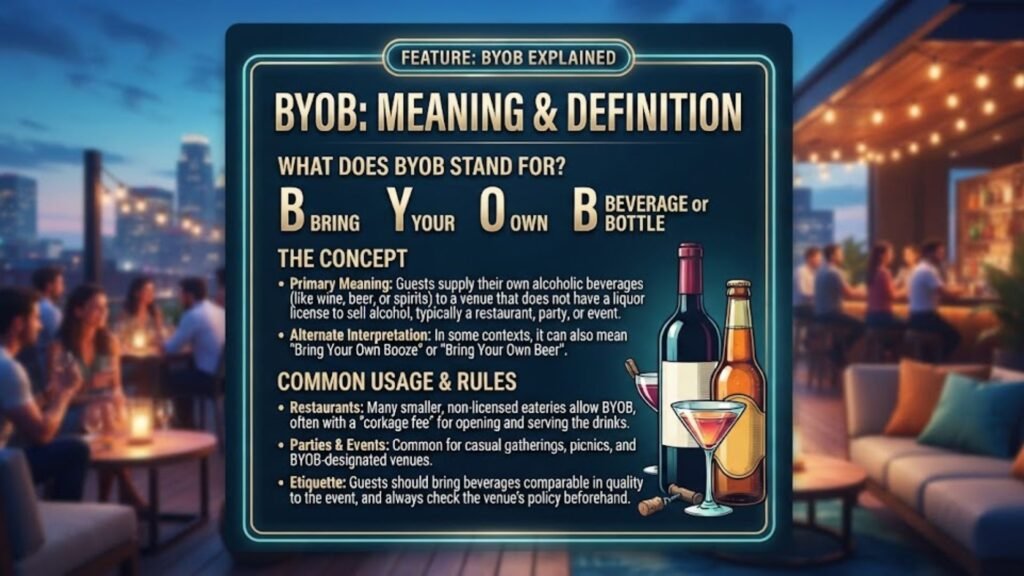
At its core, the BYOB definition is simple. It’s a BYOB acronym used to let people know they need to bring their own drinks to an event. Most often, this means alcohol, but it can stretch to any beverage depending on the setting.
The BYOB full form usually stands for “bring your own bottle,” though “bring your own beverage” and “bring your own booze” are common alternatives. Context decides which one fits.
Think of it as a shortcut for hosts. Instead of writing a full sentence explaining drink policy, they slap BYOB on the invite and save everyone some back and forth.
What Does BYOB Mean in Text
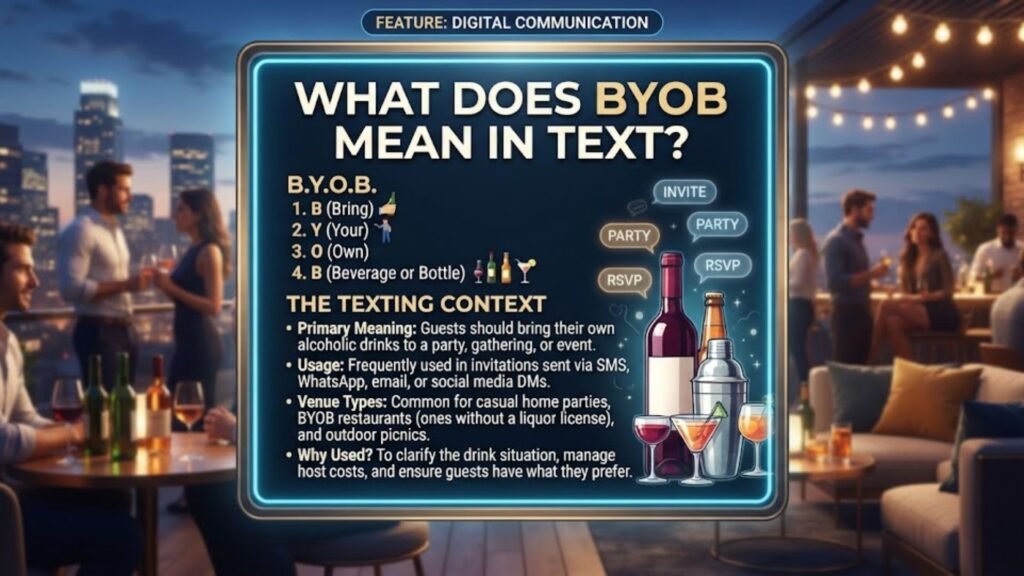
Texting moves fast, so acronyms save time. BYOB in text carries the same meaning as it does anywhere else. A friend might text “party at mine, BYOB” and you’ll know exactly what’s expected.
In casual texting context, BYOB slang meaning doesn’t shift much from its original sense. It’s still about bringing drinks, just delivered through a quick message instead of a printed card.
Group chats love this term too. Someone drops BYOB into the chat, and suddenly everyone knows to grab a six pack or a bottle of wine before heading over.
What Does BYOB Stand For
So what does BYOB stand for, exactly? The most common answer is “bring your own bottle.” That said, plenty of people use it loosely to mean “bring your own beverage” or “bring your own booze.”
The letters themselves don’t lock you into one phrase. B for bring, Y for your, O for own, and the last B could be bottle, beverage, or booze. Context clues you in on which one applies.
At a backyard barbecue, it likely means beer or wine. At a corporate mixer, it might lean toward any beverage. Reading the room (or the invite) tells you which version fits.
BYOB Meaning in Party Invitations
On a BYOB invitation, the phrase does a lot of heavy lifting. It tells guests upfront that drinks aren’t included, so nobody shows up expecting a full open bar.
Hosts use this party invitation wording to keep costs down while still throwing a fun get together. It also gives guests the freedom to bring their favorite drink instead of settling for whatever’s on offer.
If you see BYOB on a birthday party or dinner party invite, just grab something you’d enjoy drinking. Nobody expects you to bring enough for the whole crowd, just enough for yourself and maybe a little extra to share.
BYOB Meaning in Restaurants
A BYOB restaurant works a bit differently. These spots don’t have a liquor license, so instead of selling alcohol, they let customers bring their own bottles to enjoy with dinner.
Most places that allow this charge a small corkage fee, which covers opening the bottle and providing glasses. It’s a fair trade since the restaurant still needs to manage the extra service.
Before you show up with a case of beer, check the restaurant policy. Some restaurants only allow wine, while others set bottle limits or specific drink types. A quick call ahead saves any awkward moments at the door.
BYOB Meaning in Events and Gatherings
Beyond parties and restaurants, BYOB pops up at all sorts of casual gatherings. Barbecues, beach meetups, camping trips, and game nights all commonly run on this system.
The logic stays the same across every social gathering. The host covers food, space, and maybe some snacks, while guests handle their own drinks. It keeps things affordable and fair for everyone involved.
For bigger outdoor gatherings like picnics or beach days, this setup also solves a practical problem. Carrying enough drinks for a huge crowd is tough, so splitting that responsibility among guests just makes sense.
BYOB Meaning in Slang
In casual conversation, BYOB slides comfortably into slang. Friends toss it around without thinking twice, since it’s become part of everyday party talk.
This slang meaning hasn’t strayed far from the original. It still points to drinks, but the tone feels lighter and more playful when used between friends rather than printed formally.
You might hear someone say, “It’s a BYOB kind of night,” meaning grab your favorite drink and get ready to have fun. The phrase carries a relaxed, no pressure vibe.
BYOB Meaning in Business
Believe it or not, BYOB in business takes on a completely different flavor. Here, it often stands for something like “Build Your Own Brand” or “Bring Your Own Business,” especially in marketing circles.
A BYOB workshop might teach entrepreneurs how to build their personal brand from scratch. The acronym gets borrowed for its catchy sound, even though the drinks have nothing to do with it.
This shows how flexible acronyms can be. The same four letters shift meaning entirely depending on whether you’re at a party or sitting through a marketing seminar.
BYOB Origin and History
Where did BYOB origin actually trace back to? Nobody pins down one exact moment, but the phrase grew out of a practical need. Hosts wanted a simple way to tell guests they’d need to bring their own alcohol.
Over time, this popular phrase worked its way into restaurant signs, casual speech, and eventually online messaging. Its short, punchy format made it perfect for quick communication.
As invitation culture shifted toward informal, low key gatherings, BYOB became a staple. It solved a real social problem, letting hosts throw parties without covering every single drink cost themselves.
BYOB Pronunciation
Wondering about BYOB pronunciation? You say each letter individually: B, Y, O, B. There’s no blended sound here, just four clear letters spoken one after another.
Most people write it in capital letters, though you’ll occasionally spot the lowercase version in casual texting. Either way, the spoken form stays the same.
It’s a quick, easy phrase to say out loud, which probably helped it stick around in everyday language for so long.
BYOB vs BYO
So how does BYOB vs BYO break down? BYO is the shorter cousin, standing simply for “bring your own.” It’s more flexible since it doesn’t specify what exactly to bring.
BYOB narrows things down to bottles or beverages specifically. Meanwhile, BYO could mean BYO food, BYO laptop, or anything else depending on the event.
If an invite just says BYO, check for extra context. It might mean drinks, food, or even equipment, while BYOB almost always points straight to beverages.
BYOB vs Bring Your Own Bottle
Here’s the thing about BYOB vs Bring Your Own Bottle. They’re essentially the same phrase, just one is the acronym vs phrase version of the other.
BYOB is simply the shortened form. Writing out the full phrase feels more formal, while the acronym feels quicker and more casual, especially in texts or social media captions.
Restaurants sometimes spell it out fully on their signs for clarity, while friends texting each other almost always default to the shorter acronym.
BYOB vs Bring Your Own Beverage
Now let’s look at BYOB vs Bring Your Own Beverage. This comparison highlights how the same acronym can represent a specific vs general meaning.
“Bottle” leans toward alcohol, especially wine or beer. “Beverage” opens the door to literally any drink, including soda, juice, or water, making it a friendlier option for family-friendly events.
If you’re hosting a non-alcoholic event or a mixed age group gathering, clarifying “beverage” instead of “bottle” avoids any confusion about whether alcohol is expected.
BYOB Meaning Comparison Table
| Term | Full Meaning | Common Setting |
| BYOB | Bring Your Own Bottle | Parties, restaurants |
| BYOB | Bring Your Own Beverage | Family events, mixed gatherings |
| BYOB | Bring Your Own Booze | Casual house parties |
| BYO | Bring Your Own | General, includes food or items |
This table gives you a fast way to compare the different BYOB meanings side by side. Use it as a quick reference whenever you’re unsure which version applies.
Common BYOB Idioms and Related Phrases
Party culture comes packed with colorful expressions. Here’s a rundown of phrases you’ll often hear alongside BYOB.
Bring Your Own Bottle
This is the classic, most recognized version of the phrase, pointing straight to alcohol like wine or beer.
Bring Your Own Beer
A more specific spin, often used at casual backyard hangouts where beer is the drink of choice.
Bring Your Own Beverage
The most inclusive version, covering everything from cocktails to soda for a wider mix of guests.
Bring Your Own Booze
A blunt, informal way to say the same thing, popular in casual texting and group chats.
Raise a Glass
This idiom means to give a toast, usually said before everyone takes a celebratory sip.
Drink Responsibly
A reminder that having fun shouldn’t come at the cost of safe drinking habits.
On the House
This means something is free, often used when a restaurant covers a small extra like glasses.
Bottoms Up
A cheerful phrase said right before finishing a drink in one go.
Cheers to That
A friendly way to agree with something worth celebrating, often paired with clinking glasses.
Party Animal
Describes someone who loves partying and never misses a chance to have fun.
Life of the Party
This idiom refers to the person who keeps the energy high and the room entertained.
Social Butterfly
Someone who moves easily between groups, chatting and connecting with everyone at the event.
Break the Ice
Means starting a conversation to ease any initial awkwardness among guests.
Paint the Town Red
A fun way to describe going out and having a wild, memorable night.
Have a Blast
Simply means having a great time at an event or party.
Let Your Hair Down
This phrase encourages relaxing and dropping any formal behavior.
Good Company
Refers to enjoyable people who make an event feel worthwhile.
Call It a Night
Used when it’s time to head home and wrap up the celebration.
Drink Like a Fish
Describes someone who drinks a lot, often more than usual.
Wet Your Whistle
A playful way of saying it’s time to have a drink.
Practical Usage of BYOB
Wondering how BYOB usage actually plays out in real life? Picture a friend inviting you to a game night and mentioning BYOB in the group chat. You’d simply grab a six pack or a bottle of your choice before heading over.
In restaurants, this term shows up on menus or signs near the entrance. It signals that you’re welcome to bring your own wine or beer, subject to their specific rules.
Whether it’s a text, an invitation, or a sign, the practical usage stays consistent. It always means the drinks are on you, not the host or venue.
BYOB Invitation Wording Ideas
Struggling to word your own BYOB invitation? Keep it short and clear. Something like “Join us Saturday at eight, BYOB” gets the point across without sounding stiff.
For a friendlier tone, try “Come hang out this Friday night, bring your favorite drink!” This softer wording works well for family-friendly events or mixed groups.
If you want to avoid any confusion, spell it out fully once, like “Drinks not included, please bring your own beverage.” This clears up any doubt for guests unfamiliar with the acronym.
BYOB Party Rules and Etiquette
Good party etiquette matters just as much as knowing the meaning. Guests should bring enough for themselves, without assuming others will share their stash.
Respecting the host’s home is another unwritten rule. That means not overdoing it on drinks and being mindful of noise or mess as the night goes on.
Hosts, on their end, should communicate clearly. Mentioning BYOB early in the invite avoids any last minute confusion about what guests need to bring.
BYOB Restaurant Rules
Every BYOB restaurant sets its own boundaries. Some only allow wine, others accept beer, and a few might restrict quantities to a couple of bottles per table.
Corkage fees vary too. Some places charge a flat rate, while others charge per bottle opened. It’s always smart to ask the host, or in this case, the restaurant staff, before assuming anything.
Local laws also play a role here. Certain areas have strict alcohol regulations, so always check what’s legally allowed before bringing your own drinks to dinner.
How to Use BYOB Correctly
Using BYOB correctly comes down to context. Attach it to an invite when drinks aren’t included, and skip it entirely when they are.
For example, “Movie night at my place, BYOB” makes it obvious to bring a drink. On the other hand, writing “BYOB” for a fully catered event would confuse your guests.
A simple trick is to think about intent. Ask yourself if guests genuinely need to know they’re responsible for their own drinks. If yes, the acronym fits perfectly.
Common Mistakes With BYOB
One frequent slip up involves alcohol assumption. Not every BYOB event means alcohol, especially at family gatherings where “beverage” makes more sense than “booze.”
Another mistake happens at restaurants. Guests sometimes bring more bottles than allowed, leading to awkward conversations with staff about bottle limits or extra corkage charges.
Formal events cause confusion too. Slapping BYOB onto a wedding invitation might feel out of place unless it’s a casual celebration. Always match the tone of the wording to the event itself.
Conclusion
At the end of the day, BYOB meaning boils down to one simple idea: bring your own drink. Whether it shows up in a text, on a restaurant sign, or scribbled on a party invite, the message stays consistent.
Now that you understand its different shades, from casual slang to business jargon, you’ll never feel caught off guard again. Next time you spot BYOB, you’ll know exactly what to grab before heading out the door.
FAQs
What does BYOB mean?
BYOB means “bring your own bottle” or “bring your own beverage,” letting guests know they need to supply their own drinks.
What does BYOB stand for in texting?
In texting, it carries the same meaning as everywhere else, telling friends to bring their own drinks to a casual hangout.
What does BYOB mean on an invitation?
On an invitation, it signals that drinks aren’t provided, so guests should bring something to drink themselves.
Does BYOB always mean alcohol?
Not always. While it often points to alcohol, some events use it to mean any beverage, including non-alcoholic options.
What does BYOB mean at a restaurant?
At a restaurant, it means the venue doesn’t sell alcohol, so customers can bring their own bottles, usually for a small corkage fee.
What is the difference between BYOB and BYO?
BYO is more general, meaning “bring your own” anything, while BYOB specifically points to bottles or beverages.
Is BYOB formal or informal?
It’s typically informal, fitting casual parties, texts, and relaxed gatherings rather than formal events.
Can BYOB mean bring your own beverage?
Yes, this is one of the most common interpretations, especially for family-friendly or mixed audience events.
What should guests bring to a BYOB party?
Guests should bring enough drinks for themselves, and maybe a little extra to share if they’d like.
How do you write BYOB on an invitation?
Simply add “BYOB” near the event details, or spell it out fully for extra clarity if needed.
Is BYOB rude to put on an invitation?
Not at all. It’s a common, accepted way to set clear expectations about drinks for an event.
What does BYOB mean in slang?
In slang, it keeps its original meaning but carries a more playful, casual tone among friends.
What does BYOB mean in business?
In business contexts, it sometimes stands for phrases like “Build Your Own Brand,” unrelated to drinks entirely.
What is a corkage fee in BYOB restaurants?
A corkage fee is a small charge some restaurants add for opening and serving a bottle you brought yourself.
Can BYOB mean build your own burger?
In certain casual or food-related contexts, some places jokingly use it this way, though it’s far less common.

Muaz is a language enthusiast and content writer at Businessleam, creating clear, helpful articles about words, meanings, grammar, phrases, and modern English.