

Writing is the correct spelling, with one t. Writting is a common spelling mistake, and no dictionary accepts it.Maybe you typed an email and a red squiggle popped up under one of those words. Or you stared at the double t and wondered if your brain was playing tricks.
That worry is normal, even for confident writers. There’s a real reason this one confuses people, and it takes about two minutes to sort out.
Writing or Writting: Quick Answer
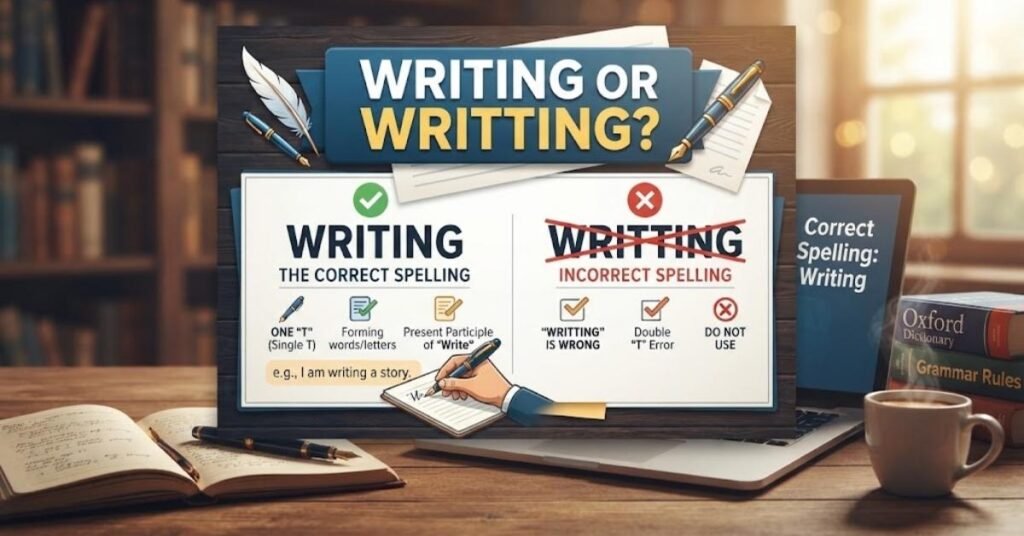
The right spelling is writing.
Writting is a plain spelling error, and it has no meaning in standard English.
Every time you use the verb write, you drop the silent e and add ing.
That gives you writing, and nothing else fits the pattern.
Examples
Here are a few sentences that show the correct form in action.
Read them once and the rhythm will stick.
- Correct: She’s writing a novel about her grandfather’s village.
- Incorrect: She’s writting a novel about her grandfather’s village.
- Correct: Good writing takes practice, not magic.
- Incorrect: Good writting takes practice, not magic.
Notice that the word works as both a noun and a verb.
The spelling stays the same either way.
The Origin of Writing or Writting
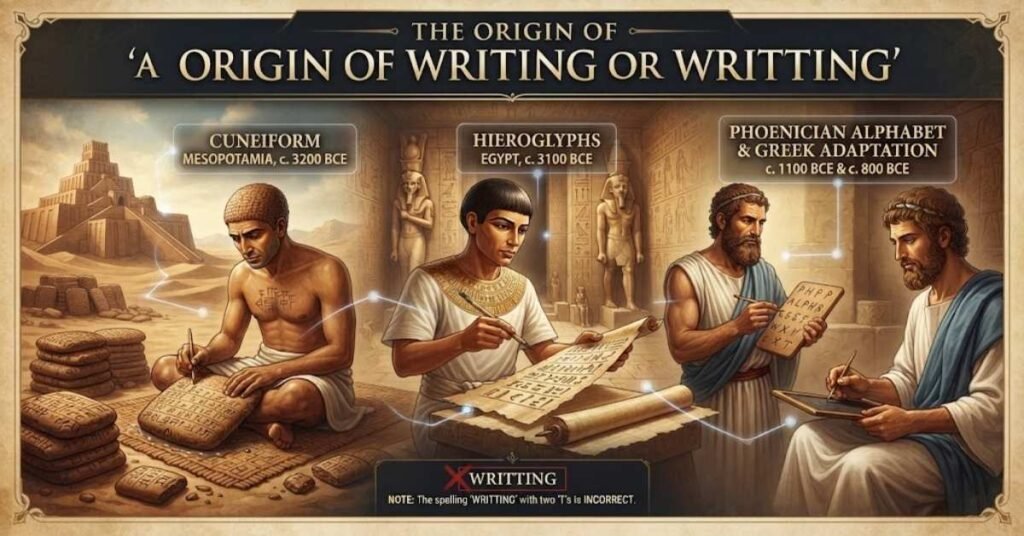
The origin of writing as a word goes back to Old English.
The Old English word writan meant to carve or scratch symbols into wood, stone, or metal.
In ancient times, nobody grabbed a pen first.
People cut marks into hard surfaces, and that physical act shaped the historical meaning of the word.
Over the centuries, the evolution of meaning moved from carving to putting words on paper.
The w you can’t hear today was once pronounced too, and writan slowly became write.
This kind of etymology also shows why writting has no history at all.
Write gave us writing, and no older form ever had a doubled t.
British English vs American English Spelling
Here’s good news for English learners.
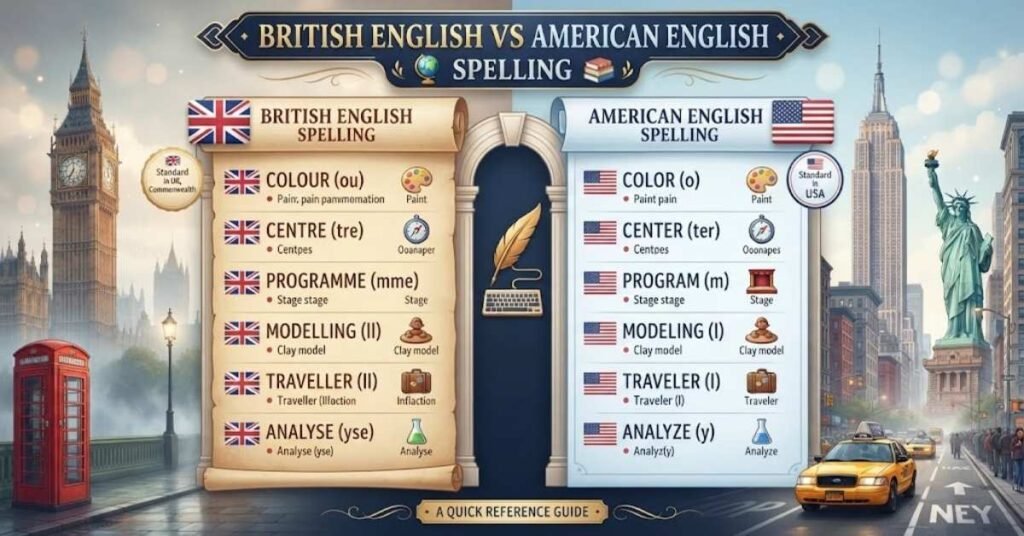
British English and American English agree on this one.
Both use writing, so there’s no regional twist to memorize.
British spelling and American spelling only split on words like colour and color, or centre and center.
So writting isn’t right in either camp.
It’s not a spelling variation. It’s just a slip.
Which Spelling Should You Use?
Use writing, every single time.
That covers school, work, texts, and anything you publish.
Check any dictionary, including Merriam-Webster, and you’ll find writing as the standard usage.
Writting won’t show up as a valid entry.
Examples
Try these quick swaps to see the write to writing change in real life.
Each one follows the same -ing form logic.
- I write every morning becomes I’m writing every morning.
- He’ll write the report tonight becomes He’s writing the report tonight.
- They write poems on Sundays becomes They’re writing poems on Sundays.
Same base word, same ending, one t.
That’s the whole trick.
Why “Written” Has Two T’s
Here’s where the confusion really starts.
The word written has a double t, so your brain assumes writing should too.
But these are different forms.
Written is the past participle, while writing is the present participle form.
The doubled t in written keeps the vowel short, just like in hidden and bitten.
Writing has a long i sound, so it doesn’t need that extra letter.
Say both words out loud and you’ll hear the difference.
Writ-ten has a quick, short i, while wry-ting stretches it out.
The Spelling Rules Behind Writing
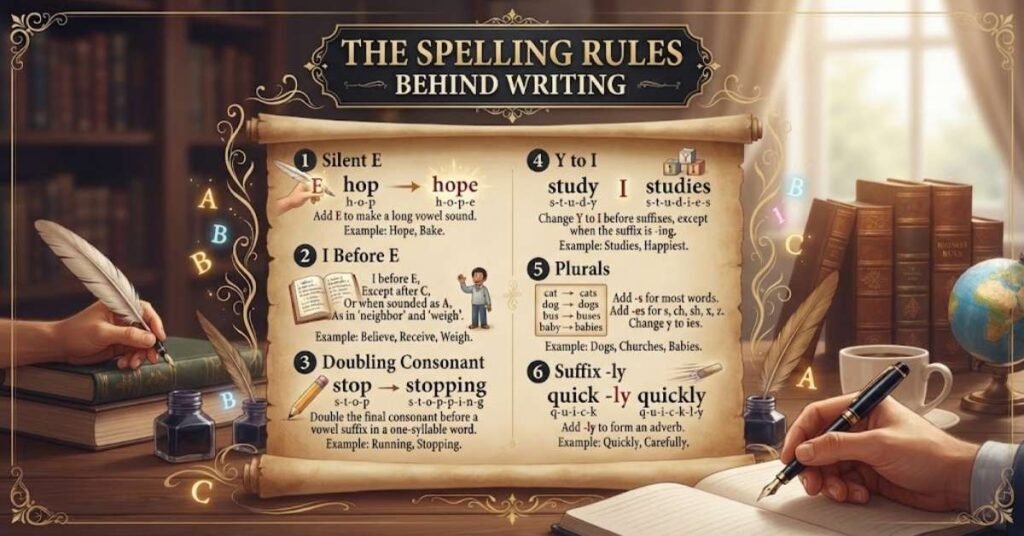
Two English spelling rules explain everything here.
One tells you when to drop a letter, and the other tells you when to double one.
The first rule covers any verb ending in silent e.
You drop the silent e and add ing.
- make becomes making
- move becomes moving
- write becomes writing
The second rule is consonant doubling.
It applies to short words like run and sit, which become running and sitting, but write ends in e, so the doubling rule never kicks in.
Words That Follow the Same Pattern
Once you see the pattern, you’ll spot it everywhere.
This table shows which words drop the e and which ones double the last letter.
| Base word | Ends in | Rule used | -ing form |
| write | silent e | Drop the e | writing |
| make | silent e | Drop the e | making |
| move | silent e | Drop the e | moving |
| take | silent e | Drop the e | taking |
| run | consonant | Double the letter | running |
| sit | consonant | Double the letter | sitting |
| stop | consonant | Double the letter | stopping |
Write sits in the first group, right next to make and move.
Nobody types makking, so writting deserves the same side eye.
Common Mistakes with Writing or Writting
Most common mistakes come from a few predictable habits.
Let’s look at three, with a quick fix for each.
Mistake 1
Many learners see running and sitting and assume every -ing word needs a double consonant.
That logic works for run and sit, but not for write.
The fix is simple.
Check the ending first, and if you spot a silent e, drop it.
Mistake 2
Because written has two t’s, people carry that extra letter into writing.
It’s an honest slip, but it’s still a spelling mistake.
Ask yourself if you’re describing an action in progress.
If yes, you need one t.
Mistake 3
Fast typing on a phone creates accidental double letters.
Your thumb taps twice, and suddenly you’ve got writting in a subject line.
In 2026, most browsers and phones underline the error right away.
But spellcheck often skips usernames, hashtags, and file names, so slow down there.
Writing or Writting in Everyday Examples
Spelling slips show up everywhere, not just in essays.
Let’s see how the correct spelling plays out in four places you probably use daily.
Picture a manager opening your email with the subject “Writting update for Friday.”
It weakens your message before anyone reads a word.
Now try “Meeting confirmation: Writing workshop at 3 PM.”
Clean, clear, and no distraction from the point.
News
Journalism runs on trust, so editors chase typos hard.
A headline like “Author finishes novel after 10 years of writing” has to be spotless.
Readers notice mistakes fast, and they love screenshotting them.
One wrong letter can hijack the whole story.
Social Media
On social media, speed beats polish, so typos slip through.
Still, a caption with writting can pull comments away from your actual point.
If you like decoding online chats, our guides on IMY meaning in text, DTTM meaning, and RS meaning in text cover popular text abbreviations.
Knowing shorthand is fun, but knowing correct spelling keeps you credible.
Formal Writing
Formal writing like a report, job application, or academic work gets judged on details.
One typo won’t sink you, but it can raise doubts about your care.
Think of it like showing up to an interview with a wrinkled shirt.
Nobody says a word, but everybody notices.
Writing or Writting: Google Trends and Usage Data
Google Trends is a handy way to see how people search for this pair.
Queries around the misspelling usually come from people checking spelling, like students, bloggers, and writers.
Keep in mind that Trends shows relative interest, not raw search volume.
Search “writing” against “writting” yourself and you’ll almost certainly see the correct spelling dominate.
Countries where the query appears often
Spelling checks cluster in places where English is a main language of school and work.
Worldwide searches come from many regions, but a few stand out.
- United States
- United Kingdom
- India
- Canada
- Australia
Numbers shift month to month.
Use the region view in Google Trends for fresh 2026 figures.
Comparison Table: Writing vs Writting
This quick table sums up the whole writing vs writting debate.
Screenshot it if you like.
| Feature | Writing | Writting |
| Correct spelling? | Yes | No |
| Meaning | The act of creating text | None, it’s a misspelling |
| Word type | Noun and verb form | Not a word |
| Dictionary listing | Yes, including Merriam-Webster | No |
| British English | Correct | Incorrect |
| American English | Correct | Incorrect |
| Formation | Write, drop e, add ing | Wrongly doubles the t |
| Example | Writing a blog post | Writting a blog post |
The pattern is easy to spot.
Only one column is safe to publish.
Easy Tricks to Remember the Right Spelling
Memory tricks work better than memorizing rules.
Here are four that English learners actually use.
- Say it out loud. The long i in writing signals a single t.
- Do the swap test. Write, drop the e, add ing.
- Compare with make. You’d never type makking, so skip writting.
- Type it three times. Muscle memory does the rest.
Pick the one that clicks for you.
Then stick with it for a week.
How to Improve Your Writing Skills and Spelling
Fixing one word is nice, but building writing skills pays off longer.
A few small habits make your clear writing stronger every week.
- Read your draft out loud. Awkward lines and typos both jump out.
- Keep a personal word list. Add every word that trips you up.
- Write daily for ten minutes. A journal, an email draft, or a short story all count.
- Use a dictionary, not just autocorrect. It shows the correct form and how it’s used.
Writing practice doesn’t need to be fancy.
Small, steady reps beat one long weekend cram session.
Why Spelling Matters for Clear Writing
Correct spelling builds trust before your reader hits the second sentence.
It also supports clarity, because typos pull attention away from your message.
Search engines are good at guessing what you meant.
Readers aren’t as forgiving, especially with professional writing like proposals and articles.
A polished page also protects your professional work.
Clients, teachers, and editors read spelling as a sign of care.
Conclusion
The answer is simple. Writing is correct, and writting is a mistake.Drop the silent e, add ing, and skip the extra t. Remember that written is the one word in the family that earns a double t.
Did this clear things up for you? Drop a comment with the spelling that trips you up most, and share this with a friend who’s still typing writting.
FAQs
1. Is writting a correct spelling?
No, writting is not correct in any dictionary. The right form is writing.It’s a common spelling mistake and worth fixing before you hit send.
2. Why do people spell writing as writting?
Most people borrow the double t from written. Others copy the running and sitting pattern by mistake.Fast typing on phones adds to the problem.
3. What is the rule for writing?
Take the verb write, drop the silent e, and add ing. That’s the same rule behind making and moving.No consonant doubling is needed.
4. Is writing spelled differently in British and American English?
No, both use writing. There’s no regional version of the spelling.British and American English only differ on other words.
5. What does writing mean?
Writing means creating text with letters, words, and symbols. It also names the text itself, like a novel, essay, or email.You’ll see it in phrases like writing a letter, writing a report, or writing poems.
6. Is writing a noun or verb?
It’s both. As a verb, it shows action, like “I’m writing a report.”As a noun, it names the activity or result, like “Her writing is sharp.”
7. Why is spelling important in writing?
Correct spelling protects your credibility. It keeps your message clear and your readers focused.It also makes your professional documents look polished and careful.

Muaz is a language enthusiast and content writer at Businessleam, creating clear, helpful articles about words, meanings, grammar, phrases, and modern English.