

If you have seen the word FUPA on TikTok, Instagram, Reddit, memes, or in a casual text, you may have wondered what it actually means. It is a popular piece of internet slang that describes a particular area of the body, but its meaning is informal rather than medical.In simple terms, FUPA commonly refers to extra fat accumulation or a soft bulge around the lower abdomen and upper pubic region.
The term can be used humorously online, although conversations about someone’s body can also be sensitive.This guide explains the FUPA meaning, its full form, common causes, how people use the term online, and realistic ways to approach lower belly fat and overall fitness.
What does FUPA mean in slang and texting?
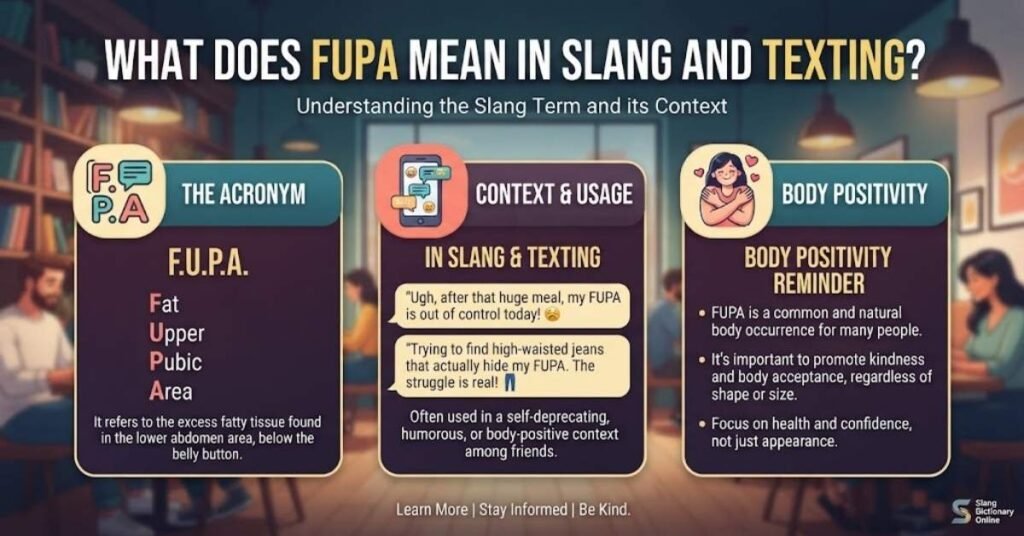
In slang and texting, FUPA usually stands for “Fat Upper Pubic Area.” People use it as an informal way to describe a belly pouch, lower belly bulge, or area of soft tissue located above the pubic bone and below the lower abdomen.
Because FUPA is an informal term, you are more likely to see it in memes, comments, jokes, private messages, and casual conversations than in formal writing.
The FUPA meaning in texting is generally the same as its meaning elsewhere online. However, the tone can change depending on context. Someone may use it jokingly about themselves, while using the same word toward another person could feel insulting or disrespectful.
FUPA meaning in social media and online conversations

On social media platforms, FUPA is often connected with discussions about body appearance, weight changes, pregnancy, fitness, and self-confidence. It can appear in captions, comments, memes, transformation videos, and fitness discussions.
The word is especially common in casual online conversations, where users frequently shorten phrases or turn body-related descriptions into humorous internet slang.
Still, context matters. A person talking about their own body may use FUPA in a lighthearted way, while commenting on another person’s appearance without permission may cross a personal boundary.
FUPA full form and real meaning explained
The commonly recognized FUPA full form is “Fat Upper Pubic Area.” It describes the soft tissue or fat that may be noticeable around the upper pubic region and lower stomach area.
The term does not identify one precise anatomical structure. People’s bodies naturally store fat differently, so what one person calls a FUPA may simply look like a normal lower abdominal area or natural body shape on someone else.
For that reason, FUPA should be understood as a descriptive slang term rather than a diagnosis. The amount of fat in this region can vary because of genetics, body composition, age, weight changes, and other individual factors.
Other meanings of FUPA in different contexts
The most common online FUPA definition is Fat Upper Pubic Area. Unlike some internet abbreviations, it does not have a widely recognized alternative meaning that is equally common in everyday texting.
Occasionally, people may use the abbreviation jokingly or creatively, but those meanings depend heavily on the specific conversation.
If you encounter FUPA in a message and the surrounding sentence does not clearly involve body appearance, check the context before assuming what the writer means.
Practical usage of FUPA in real life and online chats
FUPA is generally used in casual language, especially when people are discussing their own bodies, fitness goals, weight changes, or appearance.
For example, someone might say they are working on their fitness routine because they want to feel more comfortable with their lower stomach. In that situation, FUPA functions as informal descriptive slang.
It is usually better avoided in professional communication, workplace conversations, medical appointments, or situations where respectful language is important. A more neutral phrase such as lower abdominal fat or lower belly area is often clearer.
Comparison table: FUPA vs similar slang terms
| Term | Common meaning | Typical context |
| FUPA | Fat around the upper pubic or lower abdominal area | Internet slang and casual conversation |
| Belly fat | Fat around the stomach and abdomen | Everyday and fitness conversations |
| Pooch | A small rounded belly or lower-belly bulge | Informal body description |
| Love handles | Fat around the sides of the waist | Casual and fitness language |
| Lower belly bulge | Visible fullness in the lower abdomen | Neutral descriptive language |
| Abdominal fat | Fat stored around the abdomen | Fitness and health discussions |
These terms overlap, but they are not exact synonyms. For example, love handles generally refers to the sides of the waist, while FUPA usually points toward the lower abdominal and upper pubic region.
Using the most accurate phrase helps avoid confusion, especially when discussing body composition or fitness.
How to use FUPA correctly in sentences
Because FUPA is informal, it works best in relaxed conversations where everyone understands the slang. For example, someone might say, “I’m focusing on my overall fitness instead of worrying about my FUPA.”
Another example is, “I saw a funny FUPA meme on Instagram.” Here, the term describes the subject of the meme without being directed at a particular person.
Try not to use FUPA as a label for another person’s body unless you know they are comfortable with that kind of humor. Respectful communication matters more than using slang correctly.
Common mistakes when using FUPA in texting and slang
One common mistake is assuming that FUPA is a formal medical term. It is not generally used as a clinical diagnosis or standard anatomical term.
Another mistake is treating FUPA as something that only women experience. Both men and women can have fat stored around the lower abdomen and pubic region.
It is also easy to confuse FUPA with every type of belly fat. The terms overlap in everyday speech, but FUPA usually refers to a more specific lower-body area.
What causes a FUPA?
There is no single cause of a FUPA. Fat storage differs from person to person, and the lower abdomen can naturally be an area where the body stores fat.
Weight gain, genetics, aging, changes in activity levels, and overall body composition can influence how noticeable this area becomes. Some people naturally carry more fat around their lower stomach than others.
Pregnancy can also change the appearance of the abdomen. Post-pregnancy body changes may affect skin, muscle tone, and the distribution of tissue around the stomach and pubic area.
Can you lose FUPA specifically?
A common question is how to lose a FUPA quickly. The important point is that you generally cannot choose exactly where your body loses fat first.
Doing lower belly exercises can strengthen the abdominal muscles, but exercises alone do not guarantee targeted fat loss from the area.
A combination of regular physical activity, strength training, appropriate nutrition, sleep, and sustainable lifestyle habits can support overall fat loss when fat loss is an appropriate goal for you.
Practical ways to reduce lower belly fat
If you want to reduce overall body fat, focus on habits you can maintain rather than extreme short-term methods. Regular movement and a balanced diet can be more useful than crash diets or excessive workouts.
Strength training can help build muscle, while activities such as walking, cycling, swimming, or other enjoyable forms of exercise can increase physical activity.
Your fitness routine does not have to be complicated. Consistency usually matters more than doing an intense workout for a few days and then stopping.
FUPA exercises: what actually helps?
There is no special exercise that magically removes FUPA. However, exercises such as squats, lunges, planks, dead bugs, leg raises, and other ab workouts can strengthen different muscle groups.
A good workout routine should ideally train the whole body rather than focusing exclusively on the lower stomach.
If your goal is toning lower belly muscles, combine core exercises with full-body strength training and regular movement. This approach supports general fitness instead of promising unrealistic spot reduction.
Can diet help with a FUPA?
Nutrition can contribute to overall weight management. Instead of eliminating entire food groups without a reason, focus on a balanced eating pattern that provides protein, vegetables, fruits, whole grains, healthy fats, and adequate fluids.
If reducing body fat is your goal, a sustainable calorie deficit may be relevant, but individual calorie needs vary. Extremely restrictive diets can be difficult to maintain.
For personalized nutrition advice, especially if you have a medical condition or specific dietary needs, a qualified healthcare or nutrition professional can provide guidance suited to you.
Can you lose a FUPA in 30 days?
The phrase “lose a FUPA in 30 days” is common in online fitness searches, but there is no guaranteed 30-day transformation that works for everyone.
Changes in body weight and appearance depend on starting body composition, genetics, diet, activity, sleep, and consistency. Some people may notice changes within a month, while others may need considerably longer.
A better goal is to build consistent lifestyle changes that can continue beyond 30 days. Progress can include improved strength, energy, endurance, and fitness, not just changes in appearance.
Common idioms related to body image and appearance
English has many idioms related to appearance, health, mood, and physical condition. They are different from FUPA because they generally describe a person’s overall appearance or feelings rather than a specific body area.
Understanding these expressions can also make everyday English, social media posts, and casual conversations easier to follow.
A sight for sore eyes
A sight for sore eyes means seeing someone or something that makes you feel happy or relieved, especially after you have missed it.
For example, you might say, “You’re a sight for sore eyes!” when a friend arrives after a long absence.
Fit as a fiddle
Fit as a fiddle means being healthy and physically fit.
It is an old-fashioned but still recognizable English expression and is often used in friendly conversation.
In the pink of health
Being in the pink of health means being in very good health.
It is generally positive and can describe someone who looks or feels healthy.
A bag of bones
A bag of bones is an informal expression describing someone who appears extremely thin.
Because it comments directly on body size, it can sound insensitive when used about another person.
Like a million bucks
If someone looks like a million bucks, they look especially good, confident, or well dressed.
It is usually a compliment and is common in casual English.
Down in the dumps
Down in the dumps describes feeling sad, discouraged, or low.
Unlike FUPA, it refers to emotional state rather than physical appearance.
Skin and bones
Skin and bones describes someone who appears extremely thin.
The expression can be negative depending on context, so it should be used thoughtfully.
Larger than life
Someone described as larger than life has a strong, memorable, or unusually energetic personality.
It does not necessarily refer to physical body size.
Look like a picture
To look like a picture means to look exceptionally attractive, neat, or well presented.
It is generally used as a compliment.
Under the weather
Under the weather means feeling ill or unwell.
For example, someone might say, “I’m feeling under the weather today.”
Full of beans
A person who is full of beans is energetic, enthusiastic, or lively.
It is a cheerful informal expression.
Not a pretty sight
Not a pretty sight means something looks unpleasant or concerning.
It can refer to an object, situation, or appearance.
As fresh as a daisy
As fresh as a daisy describes someone who looks or feels energetic, refreshed, and healthy.
It is often used after a good night’s sleep or rest.
A face like thunder
Having a face like thunder means looking extremely angry or upset.
It describes facial expression rather than permanent appearance.
In bad shape
In bad shape can describe poor physical condition, health, appearance, or the condition of an object.
Its exact meaning depends on context.
Feeling blue
Feeling blue means feeling sad or emotionally down.
It is a common informal English expression.
Alive and kicking
If someone is alive and kicking, they are alive, active, and doing well.
It is usually playful or reassuring.
On top of the world
Being on top of the world means feeling extremely happy, confident, or successful.
It is often used after exciting personal or professional news.
Like a house on fire
If two people get along like a house on fire, they quickly develop a strong and friendly relationship.
It does not describe someone’s physical appearance.
Run of the mill
Run of the mill means ordinary, average, or not particularly unusual.
For example, “It was a run-of-the-mill workout” means the workout was fairly ordinary.
Is FUPA a medical term?
No, FUPA is generally an informal slang term, not a standard medical diagnosis.
A healthcare professional would normally use anatomical or clinical descriptions when discussing abdominal or pubic-area tissue.
If you notice a new lump, swelling, pain, skin change, or unusual abdominal change, it is better to discuss the symptom with a qualified healthcare professional rather than assuming it is simply a FUPA.
FUPA, body image, and self-confidence
Body-related slang can be funny in the right setting, but it can also affect body image and self-confidence. Social media often presents highly edited or carefully posed bodies, which can create unrealistic expectations.
Having some lower-belly softness does not automatically mean that someone is unhealthy. Natural body shape varies widely.
A healthy approach to fitness is to focus on physical health, strength, mobility, energy, and sustainable habits rather than judging your entire body by one feature.
Conclusion
So, what is FUPA? The common FUPA meaning is “Fat Upper Pubic Area,” an informal slang expression for fat or soft tissue around the lower abdomen and upper pubic region.The term is mostly found in internet slang, texting, memes, social media, and casual conversations. It is not a formal medical term, and it can describe a body feature that occurs naturally in both men and women.
If you want to reduce the appearance of lower-belly fat, remember that targeted fat loss is not something you can reliably control. A balanced diet, regular exercise, strength training, and sustainable lifestyle changes are more realistic than quick-fix promises.Most importantly, your body is more than one area or feature. Fitness goals should support your health and body confidence, not become a reason to shame yourself.
FAQs
What causes a woman to have a FUPA?
A FUPA woman may simply have naturally occurring fat storage around the lower abdomen and pubic region. Genetics, weight changes, aging, pregnancy, and overall body composition can influence this area.
Can men have a FUPA?
Yes. Men can have a FUPA as well. The term is not limited to women.A FUPA male may have additional fat or soft tissue around the lower abdomen and upper pubic region due to overall fat distribution, weight gain, genetics, or other individual factors.
How do you get rid of a FUPA?
There is no guaranteed exercise that specifically removes FUPA. Reducing overall body fat through sustainable nutrition, physical activity, and strength training may reduce fat in the area over time.
Are there specific FUPA exercises?
There are exercises that strengthen the core and lower abdominal muscles, including planks, dead bugs, leg raises, and other lower belly exercises.
How to lose a FUPA in 30 days?
You cannot guarantee that a FUPA will disappear within 30 days. Individual results vary depending on starting body composition, genetics, nutrition, exercise, and other factors.
Is FUPA used in medical terms?
Generally, no. FUPA is slang, not a standard medical term.Healthcare professionals are more likely to use specific anatomical or clinical terminology when discussing the lower abdomen, pubic region, fat tissue, skin, or related concerns.
Is it okay to use FUPA on social media?
Yes, people commonly use FUPA on social media, especially in humorous posts, fitness discussions, memes, and personal conversations.

Muaz is a language enthusiast and content writer at Businessleam, creating clear, helpful articles about words, meanings, grammar, phrases, and modern English.