

You saw someone type s/o in a comment and had no clue what it meant. Was it a shoutout? A significant other? Something else entirely?Here’s the short answer. S/O usually means shoutout, a quick way to give someone public recognition or credit. But it can also mean significant other, referring to a romantic partner like a boyfriend or girlfriend. The right meaning depends entirely on context.
This guide breaks down every common use of s/o, from social media captions to text messages to a few surprising professional meanings you probably haven’t heard of. By the end, you’ll never second guess this abbreviation again.
What Does S/O Mean?
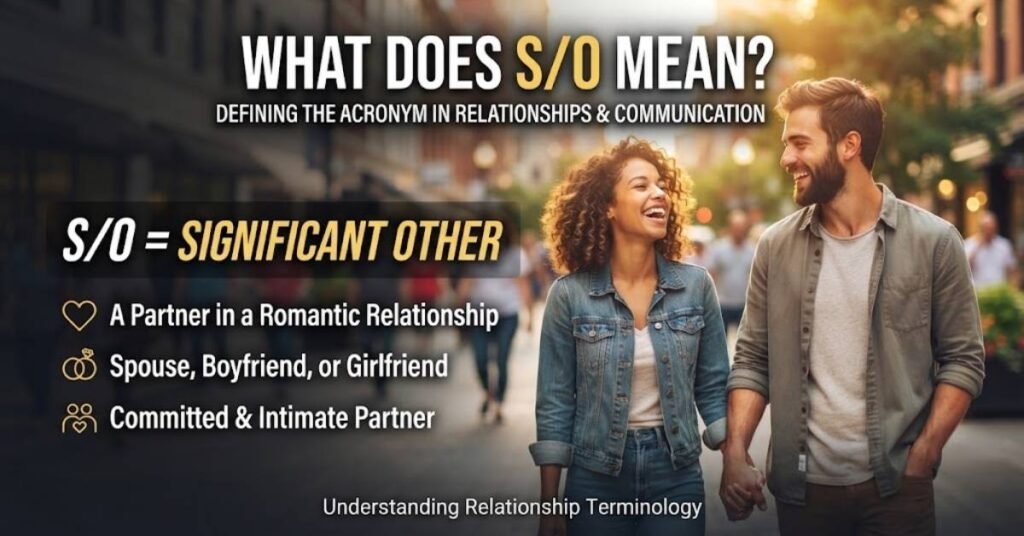
At its core, s/o is internet shorthand for two very different phrases. Most of the time, people use it to mean shoutout, a small nod of appreciation or thanks aimed at someone specific.
The other major meaning is significant other. This one shows up mostly in personal conversations, dating apps, or social media posts about relationships. Neither meaning is more “correct.” Context decides which one fits.
Primary Meaning: Shoutout
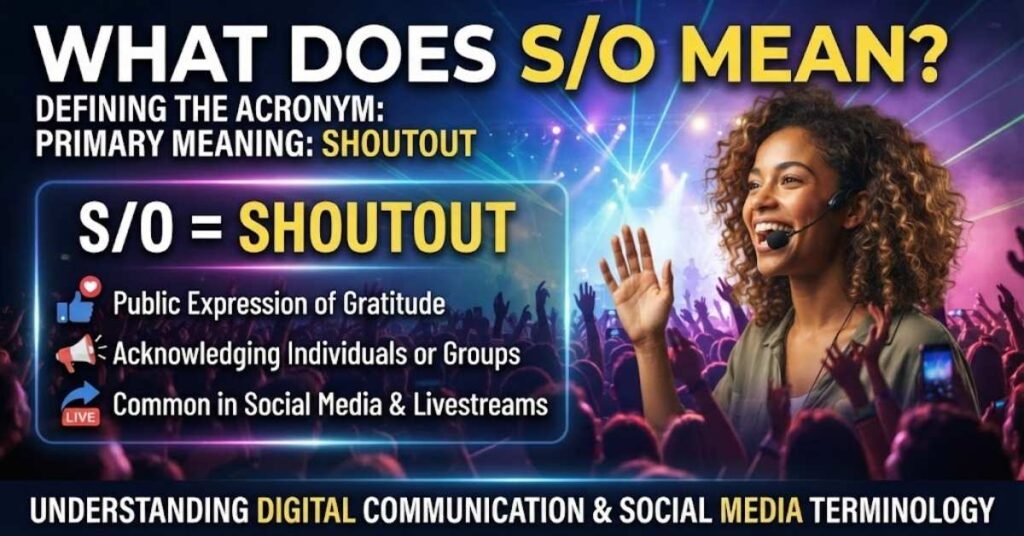
Shoutout is the most common s/o meaning you’ll run into online. It’s basically a mini spotlight, a way of saying “hey, this person deserves some praise.”
Think of it like tipping your hat to someone in a crowded room. You’re not writing an essay about them. You’re just making sure people notice their achievements or effort.
Simple Example
Someone posts a photo from a group project and writes: “s/o to my study partner for carrying us through finals week.” That’s a textbook shoutout. Quick, genuine, and easy to understand.
Other Meanings of S/O
Outside casual chat, s/o pops up in a few unexpected places. In healthcare, it can refer to surgical oncology, the medical specialty focused on cancer surgery.
In banking, s/o sometimes stands for standing order, which is a recurring instruction to make automatic payments. Businesses occasionally use it for “small office” in workplace documents too.
These meanings rarely show up in a text from your friend. But if you’re reading medical records or a professional contract, don’t assume it means shoutout or partner.
S/O Meaning on Social Media
Social media is where s/o really thrives. Instagram, TikTok, Snapchat, and X are packed with it, usually tucked into captions or comments where space and attention are both limited.
Because these platforms run on short, punchy communication, abbreviations like s/o just make sense. It’s faster to type, easier to read, and fits the casual tone people expect from social media users.
Influencers and creators especially lean on it. A shoutout on these platforms can mean real exposure, so the phrase carries more weight than its two letters suggest.
Common Social Media Uses
Here’s where you’ll spot s/o most often across different platforms and situations.
- Thanking a friend for support
- Promoting a small business or product
- Recognizing another creator’s work
- Celebrating a follower or subscriber milestone
Appreciation
This is the classic use. Someone helped you out, so you give them a public “thank you” instead of a private one. It’s recognition wrapped in two characters.
You’ll see this constantly in YouTube comments and community posts. Someone answers a question, and the original poster replies with a quick s/o to say thanks.
Promotion
Small businesses and creators use s/o to boost each other. One account gives another a shoutout, sending followers their way. It’s social media promotion in its simplest form.
This works because trust transfers. If your audience likes you, they’re more likely to check out whoever you’re vouching for.
Friendship
Sometimes there’s no bigger reason than friendship. People tag their close friends just to say “you matter to me,” especially around birthdays or big life moments.
It doesn’t need a business angle. A genuine s/o to a friend is just kindness, typed out fast.
Fan Support
Fan support is another big driver. Fans give s/os to artists, athletes, or their favorite creators as a way of showing loyalty and love.
Artists often return the favor too, thanking fans by name during livestreams or in captions. It builds a loop of appreciation on both sides.
S/O Meaning in Text Messages
Text messages work a bit differently than public posts. Here, s/o tends to split more evenly between shoutout and significant other, depending on who’s texting.
Group chats usually lean toward shoutout, since you’re often praising a mutual friend. One-on-one texts between couples or close friends lean toward the relationship meaning instead.
Examples of Shoutout in Texts
“s/o to you for remembering my coffee order every single time.” That’s a warm, casual line you’d send a friend, not a stranger. It reads like something you’d actually say out loud.
Another common one: “big s/o to the whole team, we crushed that deadline.” Notice how natural it sounds, almost like spoken language typed onto a screen.
Examples of Significant Other
“Can’t wait for date night with my s/o this weekend.” Here, the meaning flips entirely. There’s no recognition happening, just a reference to a romantic partner.
Another example: “My s/o surprised me with dinner tonight.” Swap in “boyfriend” or “girlfriend” and the sentence means the exact same thing.
Difference Between S/O Meaning as Shoutout and Significant Other
The gap between these two meanings is huge, even though the letters are identical. Shoutout is public, social, and usually about credit or thanks. Significant other is personal, private, and about romantic relationships.
One quick trick: if the sentence involves praise, achievements, or thanking someone in front of others, it’s almost certainly shoutout. If it’s about dating, love, or a partner, it’s the relationship meaning.
Another clue is the setting. Public captions and comment sections almost never use s/o to mean partner. Private texts between couples rarely use it to mean shoutout.
Why People Use S/O Instead of Full Words
Typing takes time, and character limits on platforms like X don’t help. S/O saves keystrokes without losing meaning, which matters when you’re posting fast or texting on the go.
There’s also a style element. Casual communication favors short forms the same way spoken conversation favors contractions. Nobody says “I am going to” out loud either.
Finally, internet culture rewards efficiency. Terms like LOL, TBH, and IMO exist for the same reason s/o does. Shorter phrases move faster through digital communication, and speed is currency online.
Examples of S/O in Real Life Situations
S/O isn’t locked to any one group. It shows up across very different corners of daily life, each with its own flavor.
School and College
Students give shoutouts constantly, whether it’s thanking a study group or praising a classmate who helped with notes. “s/o to my lab partner for saving our whole experiment.”
Teachers and coaches sometimes get the same treatment. A student might post about a coach who pushed the basketball team to finally win their big game.
Workplace
Coworkers use s/o in professional communication, though usually in casual internal chats rather than formal emails. “s/o to the customer service team for handling that mess so well.”
It keeps morale light. A quick public nod costs nothing but can mean a lot to whoever receives it, especially after a rough week.
Social Media Creators
For creators and influencers, s/os often double as networking. Giving a shoutout to another creator can lead to creator support flowing back the other way.
It’s a small economy of goodwill. You promote me, I promote you, and both audiences grow a little.
Relationships
Couples use s/o to casually reference each other online without spelling out “boyfriend” or “girlfriend” every time. It’s shorthand for a bond, not a formal label.
You’ll see this a lot around anniversaries, weddings, or random Tuesday posts where someone just wants to appreciate their partner publicly.
When You Should Use S/O
S/O fits best in informal settings. Think captions, texts, group chats, or casual comments where the tone is already relaxed.
It also works well when speed matters more than polish, like live event posts or quick reactions during a game or concert.
Example
Posting during graduation season: “s/o to my parents for putting up with four years of stress calls.” Nobody expects formal language here, so the abbreviation fits naturally.
When You Should Avoid Using S/O
Skip it in formal writing. Cover letters, academic papers, business proposals, and legal documents all call for full words instead of shorthand.
Also avoid it when clarity really matters and your audience might not share the same slang background, like older relatives or formal business communication with new clients.
Similar Terms and Related Slang
S/O belongs to a bigger family of appreciation-based slang. Related terms include props, mention, respect, and plain old credit.
- Props: casual praise, similar tone to shoutout
- Mention: naming someone directly in a post
- Credit: acknowledging someone’s contribution
- Respect: a nod to someone’s skill or effort
These words all circle the same idea. Someone did something worth noticing, so you say so, publicly and briefly.
Common Mistakes People Make With S/O
Even a two letter phrase can trip people up. Here are the slip ups that show up most often.
Assuming It Always Means Significant Other
This is the biggest one. Plenty of people see s/o and immediately think “partner,” even when the sentence is clearly about appreciation or recognition.
Always check the surrounding words first. Context clues almost always settle the confusion within a sentence or two.
Using It in Formal Writing
Dropping s/o into a resume or a client email looks unprofessional. Formal context calls for full, spelled out language, no exceptions.
If you’re unsure whether a setting counts as formal, err on the side of writing it out completely.
Misreading Context
Sometimes people read too fast and miss the actual meaning being used. Misreading happens especially in group chats with multiple ongoing topics at once.
Slow down for a second if a message feels confusing. The correct meaning is usually obvious once you reread the full sentence.
Adding Unnecessary Punctuation
Writing it as “s.o.” or with extra symbols can confuse readers unfamiliar with the term. Stick to the standard s/o or lowercase s o format that most platforms recognize.
Consistency helps your message land clearly, especially with younger audiences who are used to seeing it written a specific way.
Is S/O Considered Slang?
Yes, s/o counts as internet slang, though it’s mild enough to appear almost everywhere online. It’s not vulgar or exclusive to one subculture, which is part of why it spread so widely.
It sits comfortably alongside other everyday abbreviations like DM or IMO. None of these feel edgy anymore. They’re just normal parts of online communication now.
How Context Changes the Meaning of S/O
Context is genuinely the whole story with s/o. The same two characters can mean completely different things depending on where they show up.
Relationship Context
If romance, dating, or a partner is mentioned nearby, s/o almost always means significant other. “Date night with my s/o” leaves little room for confusion.
Appreciation Context
If the sentence involves thanks, praise, or public credit, you’re looking at shoutout. “s/o to everyone who showed up early” fits this pattern perfectly.
Medical Context
In healthcare settings, s/o might reference surgical oncology entirely unrelated to slang. This meaning almost never appears outside professional or academic writing.
Conclusion
S/O is one of those tiny abbreviations that carries a surprising amount of meaning. Most of the time, it means shoutout, a fast way to give someone credit or appreciation. Other times, it means significant other, pointing toward a romantic partner.
Context is your best guide every single time. Read the sentence around it, think about the setting, and the correct meaning usually becomes obvious within seconds. Once you get comfortable spotting the difference, you’ll never pause over an s/o again.
FAQs
What does s/o mean in texting?
In texting, s/o usually means either shoutout or significant other, depending on the message’s tone and topic.
Does s/o mean shoutout on Instagram?
Yes, on Instagram, s/o almost always means shoutout, especially in captions and comments giving someone public recognition.
Is s/o formal or informal?
S/O is strictly informal. Avoid it in formal writing, resumes, or professional documents where full words are expected.
Can s/o mean boyfriend or girlfriend?
Yes, s/o can mean boyfriend or girlfriend when used as short for significant other, typically in personal or relationship posts.
What is an example of s/o in a sentence?
“s/o to my best friend for always answering my 2 AM texts” uses it as shoutout, showing casual appreciation.
Why do people write s/o instead of shoutout?
People use s/o to save time and space, especially on platforms with character limits or fast-paced casual communication like texting and social apps.

Muaz is a language enthusiast and content writer at Businessleam, creating clear, helpful articles about words, meanings, grammar, phrases, and modern English.