

Have you ever received a text with an abbreviation that left you scratching your head? Internet slang can be confusing, especially when a few letters carry a whole message. One abbreviation you may spot in chats, social media comments, and online discussions is iirc. It might look like random letters at first, but it has a simple meaning that makes everyday conversations easier to follow.
So, what does it mean, and why do people use it so often? This abbreviation helps someone share a memory without claiming to be completely sure. It can make a message sound more honest, polite, and open to correction. You might see it when people discuss old conversations, dates, plans, or past events. Keep reading to learn its full form, how to use it naturally, common mistakes to avoid, and the best ways to respond.
Introduction: Why “IIRC” Confuses So Many People
Texting has changed how people communicate every day. Short forms, abbreviations, and texting slang help people send messages quickly. However, some abbreviations can leave you scratching your head. One common example is IIRC.
If you’ve seen IIRC in text messages, group chats, or online discussions, you might wonder what it means. The letters don’t immediately reveal their meaning, especially if you’re unfamiliar with internet abbreviations.
The good news? Understanding IIRC is simple once you know its full form.
People use IIRC when sharing facts from memory but aren’t completely certain. It helps them sound honest, thoughtful, and open to correction.
- IIRC full form: If I Recall Correctly
- Category: Internet abbreviation and text abbreviation
- Main purpose: Expressing memory-based information with some uncertainty
This guide explains the real meaning of IIRC, how to use it, and how it fits into modern communication in 2025 and 2026.
What Does IIRC Mean in Text?
IIRC stands for If I Recall Correctly. People use this abbreviation when they remember something but aren’t entirely sure about every detail.
In simple words, IIRC means you believe something is correct based on your memory. However, you’re leaving room for a possible mistake or correction.
For example, imagine your friend asks when a movie came out. You remember the year but haven’t checked the exact date. You could use IIRC to share what you remember without sounding too confident.
Example:
- Friend: When did that movie come out?
- You: IIRC, it came out in 2020.
Here, you’re sharing information from memory rather than making a confirmed claim.
People commonly use IIRC in texting, casual chats, forums, and comment sections. It’s a useful abbreviation when you want to balance confidence with honesty.
The Core Meaning of IIRC Explained Simply
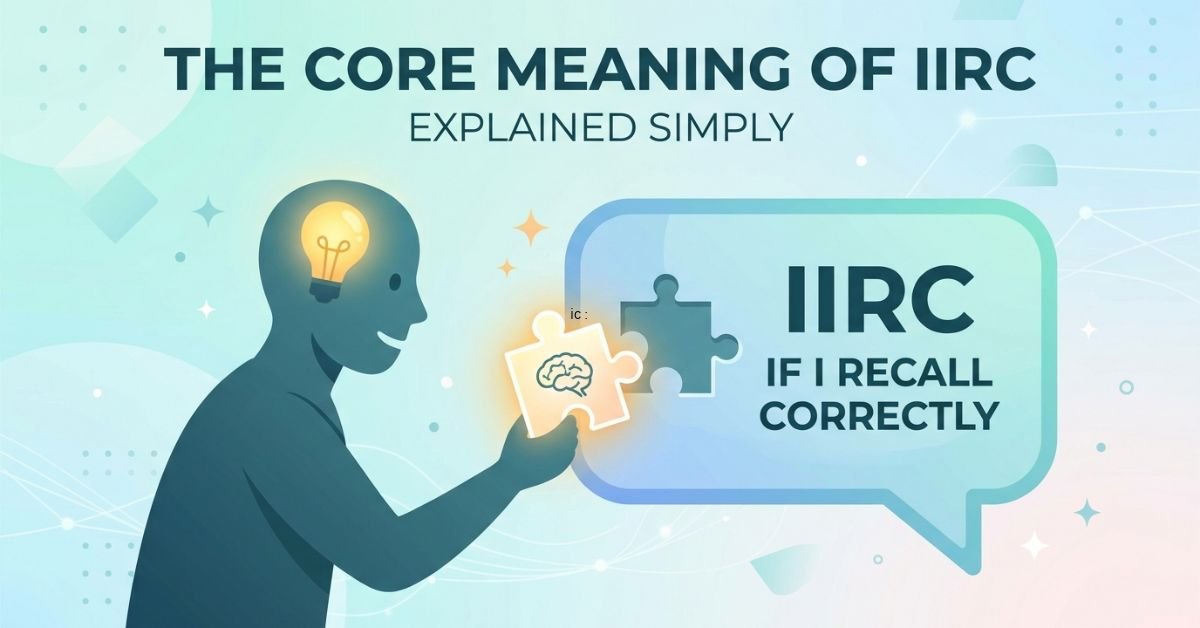
The core meaning of IIRC is straightforward. It tells someone that your statement comes from memory, not necessarily from a verified source.
When you write IIRC, you’re not saying your information is wrong. You’re simply admitting that you might not remember everything perfectly.
This small abbreviation can make a message sound more polite and thoughtful. It also creates a cooperative tone by inviting correction instead of demanding agreement.
Here is what IIRC communicates:
- Recall: You remember something from the past.
- Uncertainty: You might not be 100% sure about the details.
- Honesty: You explain that your information comes from memory.
- Openness: You allow others to correct you if necessary.
Conversation example:
- Alex: Was the meeting scheduled for Thursday?
- Sam: IIRC, it was Friday.
Sam shares a memory without presenting it as an unquestionable fact. That’s the main purpose of IIRC in everyday communication.
Why People Use IIRC in Text Messages
People use IIRC because it helps them share information without sounding overly confident. In modern texting, a few letters can communicate both a message and its intended tone.
Instead of checking every detail before replying, someone can explain what they remember. This works well when discussing old conversations, past events, timelines, and dates.
IIRC can also make disagreements feel less aggressive. Rather than insisting that someone else is wrong, you leave room for another perspective.
Here are some common reasons people use it:
- Showing honesty: You admit that your memory might be imperfect.
- Softening a statement: You avoid sounding demanding or argumentative.
- Inviting correction: You give others room to share accurate information.
- Saving time: You communicate quickly without typing the full phrase.
- Building trust: You show transparency about what you remember.
Conversation example:
- Mia: Didn’t the store close at 8 p.m.?
- Jake: IIRC, it closes at 9 p.m.
Jake offers a helpful reminder without claiming absolute certainty.
IIRC Meaning in Everyday Text Conversations
In everyday text conversations, IIRC usually appears when people discuss information they remember from earlier experiences. It works naturally in personal messages, casual chats, and conversations with friends.
You might use it when recalling a birthday, remembering someone’s advice, or discussing plans from an old conversation. It can also help when you remember a detail but need someone else to confirm it.
IIRC isn’t limited to one messaging app. People can use it in text messages, group chats, social media conversations, and other informal settings.
Common situations include:
- Remembering when an event happened.
- Recalling something a friend previously said.
- Sharing a detail about a movie or TV show.
- Discussing plans or appointments.
- Answering questions when you aren’t completely certain.
The abbreviation works best when the information is useful but doesn’t require immediate, exact confirmation.
Simple Examples
These examples show how IIRC fits into normal texting. Notice how each sentence shares remembered information while leaving room for correction.
- Remembering a place: IIRC, we ate at that restaurant last summer.
- Recalling a date: Her birthday is in August, IIRC.
- Remembering a conversation: IIRC, you said you’d be home by six.
- Discussing plans: IIRC, our appointment is next Tuesday.
- Talking about entertainment: That actor appeared in the first movie, IIRC.
Two-person conversation:
- Emma: Wasn’t our school reunion in October?
- Lily: IIRC, it was in November.
- Emma: Oh, right! November sounds correct.
You can place IIRC at the beginning or end of a sentence. Both positions work, so choose whichever sounds more natural.
IIRC Meaning in Online Discussions and Chats
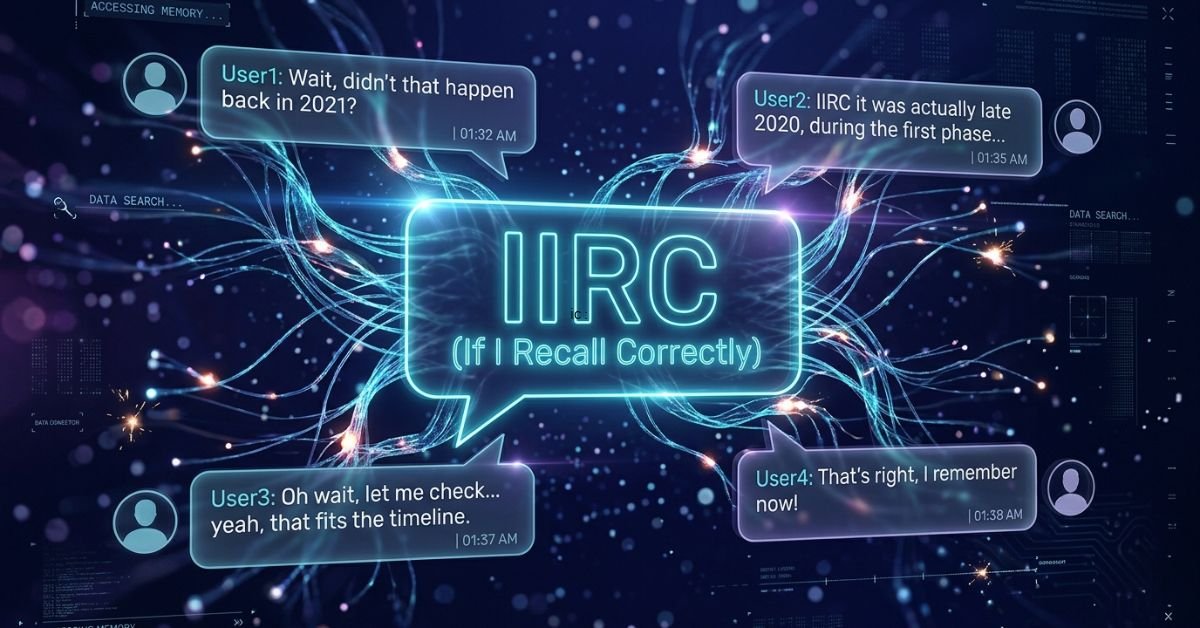
In online discussions, IIRC helps people share remembered information without sounding rude or overly forceful. You’ll often see it in forums, comment sections, gaming communities, and long conversation threads.
For example, someone might discuss an older software update or recall a rule from a previous discussion. Instead of presenting their memory as a confirmed fact, they add IIRC to show some uncertainty.
This small detail can encourage a more respectful, cooperative exchange. It helps people disagree without turning every correction into an argument.
IIRC can be especially useful when:
- Responding to questions in online forums.
- Discussing previous updates or changes.
- Recalling details from older posts.
- Sharing information in group chats.
- Correcting someone without sounding aggressive.
However, IIRC doesn’t replace fact-checking. If accuracy matters, verify the information before sharing it.
Example
Consider this conversation in an online technology forum:
- User 1: Does this app support offline mode?
- User 2: IIRC, offline mode was added in the last major update.
- User 3: You’re right! The release notes confirm it.
Here, User 2 shares a memory rather than claiming to have checked the release notes. User 3 then confirms the information.
This is a practical example of how IIRC supports transparency in online communication. It lets people contribute useful information while remaining open-minded.
The same approach works in social media comments and casual discussions. Just remember that an abbreviation can’t guarantee accuracy. When facts matter, checking a reliable source is always the better choice.
Is IIRC Slang or an Abbreviation?
IIRC is best described as an internet abbreviation that people commonly use in texting and online discussions. It stands for If I Recall Correctly and helps people share information based on memory.
Although many people group IIRC with texting slang, it doesn’t express humor, excitement, or strong emotions. Instead, it shows that someone remembers something but might not recall every detail perfectly.
You’ll often see IIRC in casual chats, forums, social media comments, and group conversations. It belongs to the wider world of internet shorthand, where people use shorter expressions to communicate quickly.
Here are a few related terms:
- IIRC: If I Recall Correctly.
- IMO: In My Opinion.
- TBH: To Be Honest.
- FYI: For Your Information.
Conversation example:
- Alex: IIRC, the event starts at seven.
- Sam: Thanks! I’ll double-check the time.
Unlike some popular slang, IIRC focuses on memory and uncertainty rather than emotions.
The Tone of IIRC: Polite, Thoughtful, and Honest
One reason people use IIRC is its ability to soften a statement. Instead of presenting remembered information as an unquestionable fact, you acknowledge that your memory might be imperfect.
This makes your message sound more thoughtful and open-minded. It also helps create a cooperative tone, especially when discussing something another person remembers differently.
However, IIRC doesn’t automatically make every message polite. Your wording and the surrounding conversation still matter.
Using IIRC can help you:
- Sound respectful when correcting someone.
- Show honesty about uncertain details.
- Avoid appearing overly confident.
- Invite others to confirm information.
- Encourage a calm, non-aggressive discussion.
Conversation example:
- Mia: Didn’t we submit the assignment on Monday?
- Noah: IIRC, we submitted it on Tuesday.
- Mia: You might be right. I’ll check my email.
Noah shares his memory without accusing Mia of being wrong. This approach can support trust and transparency in everyday communication.
How IIRC Changes the Meaning of a Sentence
Adding IIRC can change how readers interpret your message. The main information stays the same, but the wording signals that you’re relying on memory rather than confirmed facts.
Compare these two sentences:
- Without IIRC: The meeting starts at 10 a.m.
- With IIRC: IIRC, the meeting starts at 10 a.m.
The first sentence sounds definite. The second suggests that you remember the meeting time but haven’t verified it.
This small difference matters when discussing dates, appointments, instructions, or past events. It helps you communicate uncertainty without writing a long explanation.
Another example:
- Emma: The store closes at nine.
- Lily: IIRC, the store closes at nine.
Lily leaves room for correction, while Emma sounds more certain.
Still, avoid using IIRC when someone needs exact instructions. In those situations, checking the facts is better than relying on memory.
When You Should Use IIRC in Text
Knowing how to use IIRC can make your messages clearer and more natural. It’s especially helpful when you remember something but aren’t completely sure about the details.
You don’t need to use it in every message. Save it for situations where your memory matters and a little uncertainty is worth mentioning.
Use IIRC when you’re:
- Recalling information from an old conversation.
- Sharing a date or time you remember.
- Discussing something that happened in the past.
- Replying to a question without checking the facts.
- Correcting someone gently.
- Participating in casual online discussions.
Conversation example:
- Ryan: What time are we meeting tomorrow?
- Ben: IIRC, we’re meeting at 11 a.m.
- Ryan: I’ll check the group chat to confirm.
This example shows how IIRC communicates a remembered detail without guaranteeing accuracy.
For important plans, financial details, or deadlines, confirm the information before acting on it. IIRC works best when you want to help while staying honest about your memory.
When You Should Avoid Using IIRC
Although IIRC works well in everyday conversations, some situations require clearer and more precise language. The abbreviation can make a message sound uncertain when readers expect confirmed information.
For example, imagine giving someone safety instructions or explaining a strict deadline. Saying IIRC might create confusion if the information needs to be accurate.
Avoid using IIRC when:
- Writing formal documents that require precise wording.
- Giving exact instructions for an important task.
- Confirming legal, medical, or financial details.
- Sending professional emails that require a definite answer.
- Sharing information you’ve already verified and need to state clearly.
Conversation example:
- Manager: What time does the client presentation begin?
- Employee: IIRC, it’s at 2 p.m.
If the manager needs an exact time, the employee should check the calendar instead.
A clearer reply would be, “The calendar confirms that it starts at 2 p.m.”
The goal isn’t to avoid abbreviations completely. It’s to choose wording that matches the situation and gives readers the confidence they need.
IIRC Meaning in Professional vs Casual Contexts
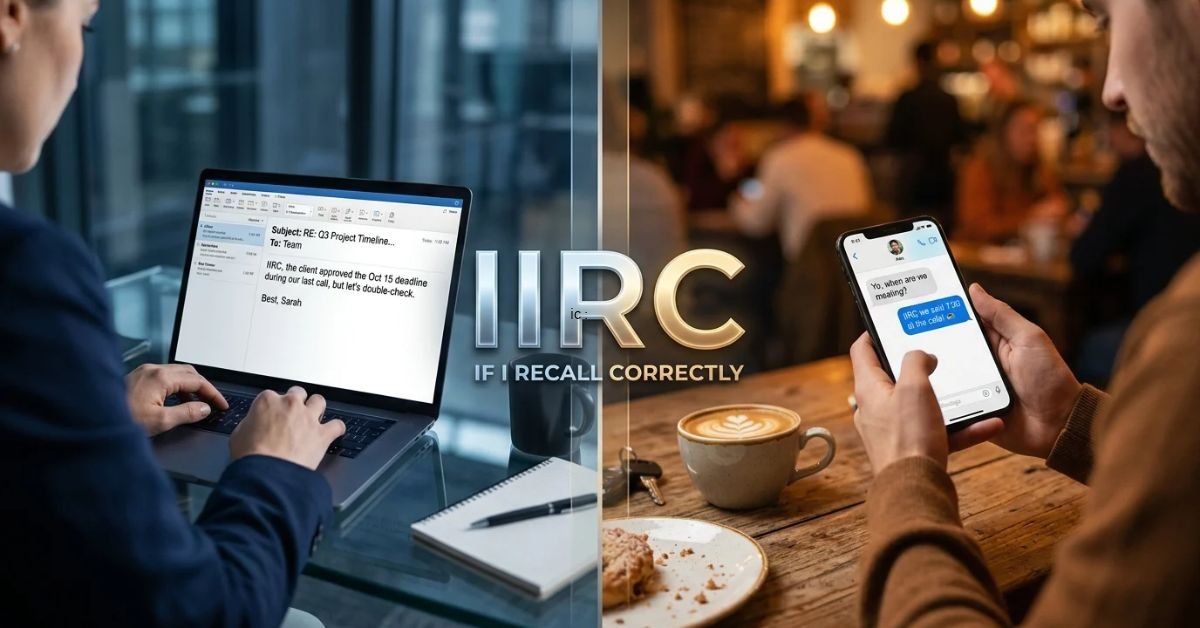
The meaning of IIRC stays the same across different settings, but its suitability depends on your audience. In casual conversations, it sounds natural and friendly. In professional communication, it may work when people understand each other and don’t need a formal tone.
Think about the difference between chatting with a coworker and sending an official business document. The first situation allows more flexibility, while the second often requires precise language.
Here’s a quick comparison:
| Situation | Is IIRC appropriate? |
| Texting friends | Yes |
| Casual group chats | Yes |
| Informal internal chats | Usually |
| Semi-formal discussions | Sometimes |
| Professional emails | Depends on the purpose |
| Formal documents | Usually avoid it |
| Exact instructions | Avoid it when accuracy matters |
Casual Context
In casual contexts, IIRC fits naturally into text messages, friendly conversations, and social media discussions. People often use it when recalling plans, remembering old conversations, or sharing facts they haven’t checked.
It keeps messages short while showing that you’re not completely certain. You can also use it to correct someone without sounding harsh or argumentative.
Conversation example:
- Ava: Wasn’t the restaurant closed on Sundays?
- Mia: IIRC, it’s open until 8 p.m. on Sundays.
- Ava: I’ll check its current hours.
This sounds relaxed and cooperative. Both people can share information without treating their memories as unquestionable facts.
Professional Context
In professional settings, IIRC can work in informal internal chats, especially when coworkers discuss past meetings or older project details. However, consider your audience before using this abbreviation in semi-formal chats or professional emails.
When accuracy matters, verify the information and communicate it directly. This is particularly important for deadlines, client commitments, official communication, and exact instructions.
Conversation example:
- Jordan: Did we agree to send the report on Thursday?
- Taylor: IIRC, we agreed on Friday. I’ll check the meeting notes.
Taylor uses IIRC appropriately because the message acknowledges uncertainty and promises verification.
For a formal email, a clearer alternative might be: “The meeting notes indicate that the report is due Friday.”
The key is to balance clarity with softness. Use IIRC when it helps, but choose precise wording when the situation demands certainty.
Is this conversation helpful so far?
IIRC Compared to Similar Text Abbreviations
IIRC stands for If I Recall Correctly. People use it when they remember something but aren’t completely sure. However, other text abbreviations express different ideas. Knowing the difference helps you choose the right phrase.
Here are some common abbreviations related to IIRC:
- IIRC: If I Recall Correctly. Use it when sharing information from memory.
- IMO: In My Opinion. Use it to express a personal view.
- TBH: To Be Honest. Use it to share an honest thought.
- FYI: For Your Information. Use it to share helpful information.
- AFAIK: As Far As I Know. Use it when sharing what you currently know.
Conversation example:
- Alex: IIRC, the store closes at 9 p.m.
- Sam: FYI, their website says 10 p.m. today.
IIRC refers to memory, while AFAIK refers to your current knowledge. These short forms make casual chats quicker, but clear wording still matters.
Common Mistakes People Make With IIRC
People sometimes misunderstand IIRC because they see it in a text message without knowing its meaning. Others use it when a direct, confident statement would work better.
Here are a few common mistakes to avoid:
- Confusing the full form: IIRC means If I Recall Correctly, not In My Opinion.
- Treating it as a confirmed fact: IIRC signals uncertainty, so the information may need checking.
- Using it in every message: Overusing abbreviations can make conversations harder to follow.
- Adding it to exact instructions: Important directions should be clear and accurate.
- Ignoring the context: The meaning is usually straightforward, but the surrounding conversation still matters.
Conversation example:
- Mia: IIRC, our appointment is on Thursday.
- Noah: Let me check the calendar before confirming.
Use IIRC when you genuinely rely on memory. If accuracy matters, check the facts instead of relying on recall alone.
Is IIRC Rude or Negative?
No, IIRC is generally not rude or negative. It usually shows that someone is sharing information from memory rather than claiming complete certainty. The abbreviation can make a statement sound more thoughtful and open to correction.
However, the tone depends on the conversation. A friendly message may sound polite, while a sharp reply can feel dismissive even when it includes IIRC.
For example, someone might use it to correct a date without sounding too forceful. They may also use it to avoid arguing over a detail they cannot fully remember.
Conversation example:
- Ella: Was the deadline next Monday?
- Ryan: IIRC, it was Tuesday, but I could be wrong.
Ryan gives his recollection without insisting that he is right. This cooperative tone invites Ella to check the information.
To keep your message respectful, use friendly wording and stay open to corrections. IIRC can soften a statement, but it cannot guarantee that the entire message sounds polite.
How to Respond When Someone Uses IIRC
When someone uses IIRC in a text, they are usually sharing something they remember. They may not be completely certain, so you can confirm the details, offer a correction, or ask for clarification.
Your response should match the conversation. A casual chat usually needs a simple reply, while a work discussion may require checking notes or records.
Here are a few ways to respond:
- If you agree: That sounds right to me.
- If you know the correct answer: I think it was actually Wednesday.
- If you are unsure: I’m not sure either. Let’s check.
- If accuracy matters: I’ll verify it and get back to you.
Example
- Ava: IIRC, the movie starts at 7 p.m.
- Leo: I think so, but let’s check the tickets.
Leo acknowledges Ava’s memory without treating it as confirmed information.
You don’t need to explain the abbreviation every time someone uses it. Simply respond to the message’s meaning. If the detail matters, verify it before making plans or sharing it with others.
Real-Life Conversation Examples Using IIRC
Seeing IIRC in real conversations makes its meaning easier to understand. People often use it when discussing dates, plans, old messages, or information they cannot remember perfectly.
Here are some examples of how IIRC works in everyday texting and online discussions.
1. Talking about plans
- Emma: What time does the party start?
- Jack: IIRC, it starts at 6 p.m.
2. Remembering an old conversation
- Mia: Did we agree to meet at the cafe?
- Noah: IIRC, yes. We discussed it last week.
3. Discussing a school assignment
- Ava: When is the homework due?
- Liam: IIRC, we need to submit it on Friday.
4. Chatting online
- Chris: Does this game support offline mode?
- Jordan: IIRC, the latest update added it.
5. Discussing work
- Sara: Was the meeting moved to Thursday?
- Ben: IIRC, yes, but I’ll check the calendar.
In each example, IIRC signals that the speaker is relying on memory. It doesn’t mean the information is definitely correct. When a date, deadline, or instruction matters, confirm it with a reliable source.
Why IIRC Is Still Popular in Modern Texting
IIRC remains useful because people often share information without remembering every detail perfectly. Instead of typing a long explanation, they can use four letters to show that a statement comes from memory.
This makes the abbreviation convenient in text messages, group chats, forums, and comment sections. It also helps people express uncertainty without making a conversation feel overly formal.
People may use IIRC when they want to:
- Recall something from an earlier conversation.
- Share a date or detail they partly remember.
- Correct someone without sounding too forceful.
- Invite another person to confirm the information.
- Keep a casual message short and clear.
Conversation example:
- Alex: When did we last update the document?
- Jamie: IIRC, we changed it on Monday.
Like other internet abbreviations, IIRC saves time when both people understand it. However, not everyone knows every texting short form. If your audience may not recognize it, writing If I Recall Correctly is clearer.
IIRC in Long Conversations and Threads
Long conversations often include details from earlier messages. You might discuss plans, revisit an old decision, or try to remember when something happened. IIRC can help you bring up a detail without claiming that your memory is perfect.
It is especially useful in group chats, online forums, and comment threads. People can share what they remember while leaving room for someone else to correct or confirm it.
Conversation example:
- Mia: Did we decide which design to use?
- Noah: IIRC, we chose the blue version.
- Ava: I thought we picked the green one.
- Noah: You might be right. Let me check the earlier messages.
This exchange shows why context matters. IIRC introduces a memory-based answer, but it doesn’t settle a disagreement.
When a long thread contains important details, check the original messages or shared documents. That simple step helps everyone stay on the same page and prevents small misunderstandings from growing.
Cultural Insight on Language Use
IIRC is part of the wider language used in digital communication. Like IMO, TBH, and FYI, it helps people share ideas quickly without typing a full phrase every time.
Its use depends on the audience, platform, and situation. Someone who regularly chats online may recognize IIRC immediately. Another person may prefer the full phrase because they rarely use internet abbreviations.
People use IIRC in several settings:
- Text messages: To recall plans, dates, or details.
- Social media: To respond to posts or comments.
- Online forums: To share remembered information during discussions.
- Work chats: To mention a previous decision when the tone is informal.
Conversation example:
- Kim: IIRC, that feature was available last year.
- Max: I remember that too, but I’ll check the release notes.
Modern texting continues to change as people adopt new short forms. Still, clarity matters across age groups and communities. When you aren’t sure your audience understands IIRC, write the full phrase or explain what you mean.
How IIRC Helps Build Trust in Conversations
Trust grows when people communicate honestly about what they know and what they cannot remember. IIRC can support that kind of communication because it signals that a statement comes from memory, not necessarily from verified information.
Instead of presenting a detail as unquestionably true, you leave room for discussion. This can make everyday conversations feel more cooperative and less confrontational.
IIRC may help you:
- Show that you are not completely certain.
- Invite others to correct or confirm a detail.
- Avoid sounding overly confident about a memory.
- Discuss past events with an open mind.
- Keep a disagreement respectful.
Conversation example:
- Sam: IIRC, we sent the form last Tuesday.
- Riley: I think it was Wednesday.
- Sam: Thanks for catching that. I’ll check the email.
Sam stays open to correction instead of arguing over an uncertain memory.
However, using IIRC doesn’t automatically make a statement trustworthy. You still need to be honest and verify important details. In professional or high-stakes situations, rely on records and accurate sources rather than memory alone.
Frequently Asked Questions
What does IIRC mean in text messages?
IIRC means If I Recall Correctly. People use iirc when sharing something they remember but aren’t completely sure about.
Is IIRC commonly used today?
Yes, iirc still appears in text messages, social media comments, online forums, and casual chats.
Can IIRC be used in professional settings?
Yes, iirc works in informal work chats. For formal emails, use clear wording to avoid confusion.
Does IIRC mean someone is unsure?
Yes, iirc signals that someone relies on memory and may not remember every detail correctly.
Is IIRC the same as guessing?
No, iirc refers to remembered information, while guessing means estimating something without enough knowledge or reliable memory.
Conclusion: Final Thoughts
Understanding iirc makes online conversations much easier. It stands for If I Recall Correctly and shows that someone is sharing information from memory. You may see iirc in text messages, group chats, social media comments, and online discussions. People use iirc when they remember a detail but aren’t fully sure about it. It can make a message sound polite, honest, and open to correction. Now, when you see iirc, you’ll know what the sender means.
You can also use iirc when talking about past events, old conversations, dates, or plans. Just remember that iirc doesn’t mean the information is always correct. If a detail matters, check it before relying on it. You can respond to iirc by agreeing, sharing a correction, or checking the facts together. Once you understand iirc, you’ll find it easier to read and use this common texting abbreviation in everyday chats.

Muaz is a language enthusiast and content writer at Businessleam, creating clear, helpful articles about words, meanings, grammar, phrases, and modern English.