

Have you ever written a date, birthday, or anniversary and suddenly stopped at the number 22? You’re not alone. The ending can look confusing, especially when you’re unsure whether to write 22nd or 22th. One small spelling mistake can make your writing look less polished. The good news is that the rule is simple once you understand it. In this guide, you’ll learn the correct ordinal form, why it uses a specific suffix, and how to remember the rule without confusion. You’ll also see clear examples from everyday writing, including emails, invitations, social media posts, and formal documents. Whether you’re a student, English learner, or simply checking your spelling, this guide will help you write the number correctly with confidence. By the end, you won’t need to guess which form belongs after 22 again.
22th or 22nd – Quick Answer
When you compare 22nd or 22th, only one form follows standard English grammar. The correct ordinal form is 22nd. The spelling 22th is incorrect in standard English.
You use 22nd when you show the position, order, or sequence of number 22. It commonly appears with dates, birthdays, anniversaries, and floor numbers.
- 22nd birthday ✅
- June 22nd ✅
- 22nd floor ✅
- 22nd anniversary ✅
- 22th birthday ❌
- June 22th ❌
For example, you might say:
“My appointment is on the 22nd.”
Think of 22nd as the short form of twenty-second. The ending -nd comes from the ordinal word second.
Simple Rule
The easiest way to understand 22nd or 22th is to look at the last digit. English ordinal numbers usually follow a predictable suffix pattern.
Numbers ending in 1, 2, or 3 generally take st, nd, or rd. Other numbers normally take th.
- 21 → 21st
- 22 → 22nd
- 23 → 23rd
- 24 → 24th
- 31 → 31st
- 32 → 32nd
- 42 → 42nd
So, because 22 ends in 2, its ordinal suffix is -nd.
A quick conversation makes the rule clearer:
“Which date is the meeting?”
“It’s on the 22nd.”
“Should I write 22th?”
“No. Write 22nd.”
This last digit rule works in most cases, but remember the special exceptions involving 11th, 12th, and 13th.
The Origin of 22th or 22nd
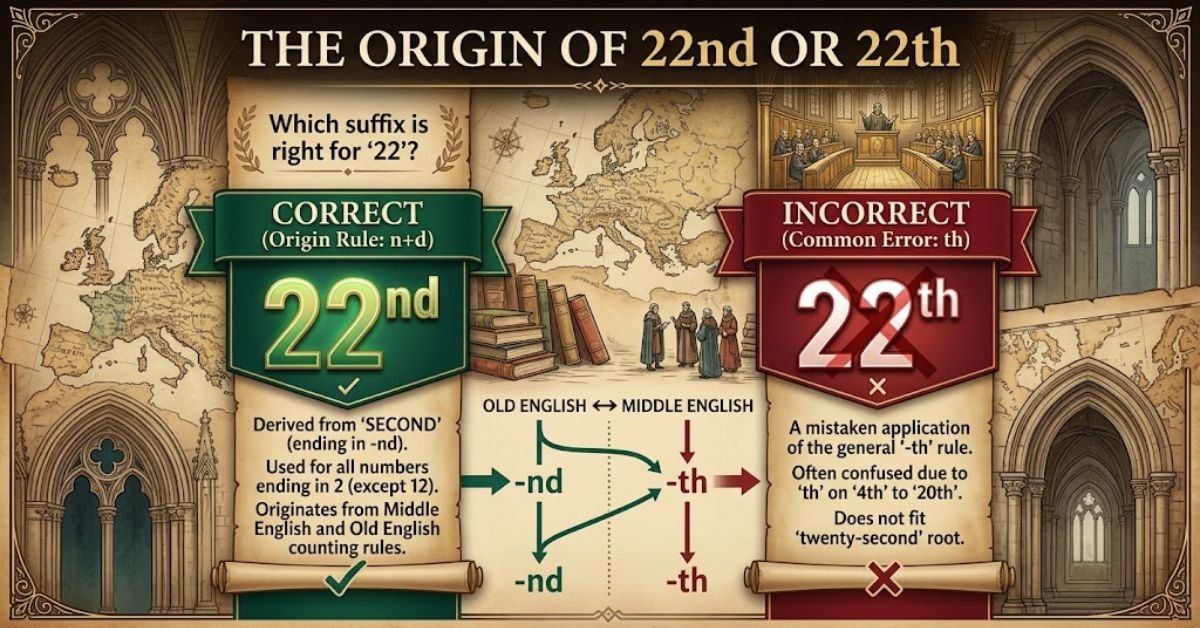
To understand 22nd, it helps to look at ordinal numbers. These numbers describe position, order, or sequence rather than quantity.
For example, one, two, and three are cardinal numbers. First, second, and third are ordinal numbers.
The word twenty-second comes from the ordinal word second. That connection explains why the abbreviation ends with nd.
- 2 → second → 2nd
- 22 → twenty-second → 22nd
- 32 → thirty-second → 32nd
- 42 → forty-second → 42nd
The form 22th doesn’t follow this established ordinal pattern. It comes from overapplying the common -th ending.
For instance, English uses 4th, 5th, 6th, 10th, and 20th. A writer may see this pattern and assume every number needs th.
That assumption creates the common mistake.
In everyday English, you can see 22nd in many places:
- 22nd birthday
- 22nd anniversary
- 22nd chapter
- 22nd floor
- 22nd position
The important point is simple: 22nd is the standard ordinal form, while 22th is not dictionary accepted as the normal English form.
British English vs American English Spelling
Good news for English learners: 22nd or 22th doesn’t change between British English and American English.
Both varieties use 22nd as the correct ordinal form. There isn’t a regional spelling difference here.
You can therefore use 22nd when writing for readers in the United States, United Kingdom, Canada, India, Pakistan, or other international English settings.
- British English: 22nd ✅
- American English: 22nd ✅
- International English: 22nd ✅
- British English: 22th ❌
- American English: 22th ❌
This rule concerns grammar rather than regional spelling.
For example:
US writer: “The conference begins on June 22nd.”
UK writer: “The conference begins on June 22nd.”
The wording around dates can vary between regions. However, the ordinal suffix itself stays the same.
So, whether you’re preparing an academic paper, school assignment, business document, invitation, or social media post, 22nd remains the safe choice.
Comparison Table
| Form | British English | American English | Standard English |
| 22nd | Correct | Correct | Yes |
| 22th | Incorrect | Incorrect | No |
| twenty-second | Correct | Correct | Yes |
There is no special British or American version of 22nd.
If someone asks, “Is 22th correct in American English?”, the answer is still no.
If a UK reader asks the same question, the answer doesn’t change. 22nd works for both audiences.
Which Spelling Should You Use?
Choose 22nd whenever you need the ordinal form of 22. It works in casual messages as well as formal writing.
You’ll see it in dates, birthdays, anniversaries, invitations, emails, news reports, and professional documents.
For example:
- My 22nd birthday is next week.
- The meeting takes place on the 22nd.
- Their 22nd anniversary is in June.
- Our office is on the 22nd floor.
- The conference starts on the 22nd.
Avoid 22th because it can make your writing look careless or unprofessional.
Imagine receiving an invitation that says, “Join us for our 22th anniversary.” The meaning remains clear, but the spelling immediately stands out.
A small correction makes the sentence look polished:
“Join us for our 22nd anniversary.”
Whether you’re writing for a US, UK, or global audience, you don’t need a different suffix.
Use 22nd consistently. That’s the simplest way to maintain clarity and confidence in writing.
Audience-Based Usage
Different audiences may read your writing, but the ordinal form stays unchanged.
| Audience | Correct Form | Example |
| US audience | 22nd | July 22nd |
| UK audience | 22nd | July 22nd |
| Global audience | 22nd | July 22nd |
| Students | 22nd | 22nd assignment |
| Business readers | 22nd | 22nd meeting |
Consider this short exchange:
“I’m sending this invitation to people in the US and UK. Which form should I use?”
“Use 22nd for both.”
The same applies to academic papers, school assignments, emails, business documents, news, and social media posts.
You don’t need to memorize separate regional versions. Just remember that 22nd follows the standard ordinal suffix pattern.
Common Mistakes with 22th or 22nd
The most common mistake happens when writers apply -th to every ordinal number.
That approach works for many numbers. For example, 24th, 25th, and 26th are correct. However, 22 follows a different suffix pattern.
Because 22 ends in 2, it normally takes -nd.
Common mistakes include:
- 22th birthday ❌
- 22th anniversary ❌
- June 22th ❌
- 22th floor ❌
- 22th meeting ❌
The correct versions are:
- 22nd birthday ✅
- 22nd anniversary ✅
- June 22nd ✅
- 22nd floor ✅
- 22nd meeting ✅
These errors often appear in quick messages, invitations, school assignments, and social media posts.
If you catch 22th in your draft, don’t worry. Replace it with 22nd.
Common Errors and Fixes
| Incorrect Form | Correct Form |
| 22th birthday | 22nd birthday |
| June 22th | June 22nd |
| 22th anniversary | 22nd anniversary |
| 22th floor | 22nd floor |
| 22th appointment | 22nd appointment |
| 22th conference | 22nd conference |
These corrections follow the same grammar rule every time.
For example, a student might write:
“My teacher gave us the 22th assignment.”
The correction is:
“My teacher gave us the 22nd assignment.”
Likewise, an event organizer should write 22nd anniversary, not 22th anniversary.
The incorrect vs. correct form becomes easy to spot once you recognize the suffix pattern.
Incorrect Example
Here’s a typical sentence containing the wrong form:
“Our company will celebrate its 22th anniversary this year.”
The problem isn’t the sentence structure. The problem is the ordinal suffix attached to 22.
Another common example appears in date writing:
“The event will take place on June 22th.”
That form doesn’t follow standard English grammar.
You might also see the mistake in informal conversations:
“I’m turning 22th next month.”
Although people can understand the intended meaning, 22th isn’t the correct ordinal form.
These errors often happen because writers remember the th suffix from numbers such as 10th, 15th, and 20th.
However, 22 belongs to the -nd pattern.
When you notice 22th, pause for a second. Check the final digit before choosing the suffix.
Correct Example
Now replace the incorrect suffix with -nd.
“Our company will celebrate its 22nd anniversary this year.”
That sentence follows standard English grammar and sounds natural.
For dates, you can write:
“The event will take place on June 22nd.”
For birthdays:
“She’s celebrating her 22nd birthday this weekend.”
For buildings:
“Their office is located on the 22nd floor.”
For appointments:
“My dentist appointment is scheduled for the 22nd.”
Notice how the same pattern works across different contexts.
You don’t need to learn each expression separately. Once you understand the ordinal form of 22, you can apply it to birthdays, dates, anniversaries, meetings, and other situations.
A simple conversation might sound like this:
“Is June 22th okay?”
“Almost. Write June 22nd.”
That small change makes the sentence grammatically correct.
Why the Mistake Happens
Why do people write 22th when 22nd looks so different? The answer lies in the way English ordinal endings work.
Most ordinal numbers use th, so writers often treat it as the default suffix.
For example:
- 4th
- 5th
- 6th
- 7th
- 8th
- 9th
- 10th
After seeing that pattern repeatedly, someone may naturally write 22th.
This is called overapplying the “th” rule. The writer knows a real rule but applies it too broadly.
The last digit rule provides a better shortcut.
Look at the final digit:
21 → 21st
22 → 22nd
23 → 23rd
24 → 24th
That sequence makes the pattern much easier to remember.
English learners can use this approach without memorizing hundreds of ordinal forms. Native speakers can use it too when a number makes them hesitate.
The key is to check the suffix pattern before you write.
Easy Rule for Ordinal Numbers
Ordinal numbers tell you where something falls in a sequence. Words such as first, second, and third describe position or order.
Cardinal numbers simply count things:
one, two, three, four.
Ordinal numbers show sequence:
first, second, third, fourth.
When you shorten ordinal numbers, English uses four main endings: st, nd, rd, and th.
| Number Ending | Ordinal Suffix | Example |
| 1 | st | 21st |
| 2 | nd | 22nd |
| 3 | rd | 23rd |
| 4–0 | th | 24th |
This creates the familiar last digit rule.
For example:
- 21st
- 22nd
- 23rd
- 24th
- 31st
- 32nd
- 42nd
So, when you see 22th, check the final digit. The number ends in 2, which points to nd.
That gives you 22nd.
This easy rule works beautifully in everyday writing. Still, there’s one important detail to remember: 11, 12, and 13 don’t follow the ordinary last-digit pattern.
Exceptions
The last digit rule has three major exceptions: 11th, 12th, and 13th.
These numbers always take th, even though they end in 1, 2, and 3.
So you write:
- 11th ❌ 11st
- 12th ❌ 12nd
- 13th ❌ 13rd
After 13, the regular pattern returns:
- 21st
- 22nd
- 23rd
- 24th
- 31st
- 32nd
- 42nd
Here’s a useful way to remember it:
11, 12, and 13 are the special trio.
For example:
“Her 12th birthday is tomorrow.”
Not 12nd.
“The meeting is on the 13th.”
Not 13rd.
Then:
“The next meeting is on the 22nd.”
Not 22th.
This exception matters because simply checking the final digit isn’t always enough. Check the final two digits first. If they are 11, 12, or 13, use th.
That small habit will help you avoid many ordinal-number mistakes.
22th or 22nd in Everyday Examples
Knowing the rule is useful, but seeing 22nd or 22th in real sentences makes it easier to remember. In standard English, 22nd is always the correct ordinal form.
You can use 22nd when talking about a date, position, birthday, anniversary, meeting, or floor number. The incorrect form 22th often appears when someone overapplies the common -th ending.
Here are some everyday examples:
- 22nd birthday
- 22nd anniversary
- June 22nd
- 22nd floor
- 22nd meeting
- 22nd position
Imagine checking an invitation and seeing 22th. You’d probably notice it immediately once you know the pattern.
The same rule works across emails, news stories, social media posts, formal writing, and invitations.
Emails
Emails often contain dates for meetings, appointments, deadlines, and events. That’s where the difference between 22nd or 22th can appear.
When you’re writing an email, use 22nd because it follows standard English grammar.
For example:
“Our meeting is scheduled for June 22nd.”
Or:
“Please submit the report by the 22nd.”
You might also write:
- The appointment is on the 22nd.
- I’ll be available on June 22nd.
- The deadline falls on the 22nd.
- Our 22nd meeting starts at 10 a.m.
A quick conversation could look like this:
“Should I write June 22th in the email?”
“No. Use June 22nd.”
Using the correct ordinal suffix helps your business emails look polished. It also improves clarity when you’re communicating dates with clients, coworkers, or students.
News
News writing frequently mentions dates, anniversaries, events, and historical milestones. Correct ordinal forms help keep those sentences clean and professional.
A news report might say:
“The festival will begin on June 22nd.”
Another report could state:
“The company marked its 22nd anniversary this week.”
Common examples include:
- The election takes place on the 22nd.
- The team reached its 22nd final.
- The 22nd annual event begins Friday.
- Officials met on the 22nd.
News readers don’t expect 22th in carefully edited writing.
If an editor sees 22th, they would normally change it to 22nd.
Reporter: “Is the event scheduled for the 22th?”
Editor: “Change that to 22nd.”
The same grammar rule applies whether you’re writing a short news update or a longer article. The number 22 takes -nd because its final digit is 2.
Social Media
Social media posts often use dates for birthdays, celebrations, launches, countdowns, and announcements. Even casual posts should use 22nd when you choose an ordinal form.
For example:
“Counting down to my 22nd birthday!”
You could also write:
- “Our 22nd anniversary deserves a celebration!”
- “See you on the 22nd!”
- “Twenty-second chapter of this beautiful journey.”
- “The 22nd is finally here!”
You may see 22th in comments or informal posts. However, being casual doesn’t change the English grammar rule.
Here’s a simple exchange:
“My birthday is June 22th!”
“Looks great! Just change 22th to 22nd.”
If you’re creating a caption, announcement, or profile post, 22nd gives your writing a cleaner appearance.
The rule remains the same across Instagram, Facebook, X, TikTok, and other social platforms.
Formal Writing
Formal writing demands careful spelling and grammar. That includes academic papers, business documents, reports, applications, and official notices.
When number 22 appears as an ordinal, use 22nd.
For example:
“The study was completed during the 22nd week.”
Other examples include:
- The 22nd chapter discusses the results.
- The meeting will take place on the 22nd.
- The organization held its 22nd conference.
- The office occupies the 22nd floor.
Using 22th can make otherwise polished writing look careless.
Consider this sentence:
Incorrect: “The report was submitted on the 22th day.”
Correct: “The report was submitted on the 22nd day.”
The difference is tiny, yet the correct form creates a stronger impression.
Whether you’re preparing academic writing or professional writing, check ordinal suffixes before submitting important documents.
Invitations
Invitations often include dates, anniversaries, birthdays, weddings, conferences, and other special events. Since these messages represent an occasion, correct spelling matters.
Use 22nd when number 22 appears as an ordinal.
For example:
“Join us on June 22nd for our anniversary celebration.”
You can also write:
- “Celebrating our 22nd anniversary.”
- “Save the date: June 22nd.”
- “You’re invited to our 22nd annual dinner.”
- “Please join us on the 22nd.”
Here’s a natural exchange:
“The invitation says June 22th. Is that okay?”
“Change it to June 22nd before sending it.”
An invitation doesn’t need complicated grammar. One correct suffix is enough to make the date look polished.
For weddings, birthdays, corporate events, and family celebrations, 22nd is the standard choice.
22th or 22nd – Google Trends & Usage Data
Searches for 22th or 22nd reflect a common grammar question. People often type variations such as “Is 22th correct?” or “How to write 22nd” when they’re unsure about the ordinal suffix.
Search interest doesn’t mean 22th is an accepted alternative. It usually shows that people want to verify which form follows standard English grammar.
Google Trends can help researchers examine relative search interest over time. However, trend data shouldn’t be treated as a dictionary or grammar authority.
The reliable grammar answer remains straightforward:
22nd is correct.
22th is incorrect in standard English.
If you research this keyword, focus on explaining the underlying ordinal rule rather than simply repeating search phrases.
Why People Search This Keyword
People search 22th or 22nd because English ordinal numbers have several suffixes. The pattern can feel confusing, especially for English learners.
Most people already know forms such as 4th, 5th, 6th, and 10th. That makes 22th seem reasonable at first glance.
Common keyword searches include:
- Is 22th correct?
- 22th or 22nd
- How to write 22nd
- 22nd meaning
- Is 22nd correct?
- How do you spell 22nd?
The confusion usually disappears once someone learns the last digit rule.
For example:
“I know 24th is correct. Why isn’t 22th correct?”
“Because 22 ends in 2, so it takes nd.”
This is why explaining the rule matters more than simply labeling one spelling wrong.
Popular Countries
People learning English around the world may search for answers about 22nd or 22th. Search interest can come from native speakers, students, teachers, writers, and international English users.
Potential audiences include readers in:
- United States
- United Kingdom
- India
- Pakistan
- Canada
- Other English-learning communities
However, country-level search interest can change over time. Google Trends data measures relative interest rather than proving that a particular country has the highest absolute number of searches.
The grammar itself doesn’t change based on location.
A reader in the United States uses 22nd. A reader in the United Kingdom uses 22nd. The same applies to international English.
So, whether you’re writing for a US audience, UK audience, or global audience, 22nd remains the correct choice.
Usage Contexts
The ordinal form 22nd appears in many everyday situations. It can describe a date, position, sequence, or specific place.
Common contexts include:
- Dates: June 22nd
- Birthdays: 22nd birthday
- Anniversaries: 22nd anniversary
- Invitations: Join us on the 22nd
- Emails: Meeting on the 22nd
- Business documents: 22nd annual report
- Academic writing: 22nd chapter
- School assignments: 22nd question
- News: 22nd annual event
- Floor numbers: 22nd floor
- Conferences: 22nd conference
- Appointments: Appointment on the 22nd
For example:
“Where is the conference?”
“It’s on the 22nd floor.”
The context changes, but the ordinal form doesn’t.
This wide range of uses explains why learning 22nd is worthwhile. One simple grammar rule can improve your writing in many situations.
Comparison Table: 22th vs 22nd
The difference between 22th or 22nd is simple once you compare the two forms directly.
| Feature | 22nd | 22th |
| Correct ordinal form | Yes ✅ | No ❌ |
| Standard English | Correct | Incorrect |
| Ordinal suffix | -nd | -th |
| Word form | Twenty-second | Not standard |
| Birthday example | 22nd birthday | 22th birthday ❌ |
| Date example | June 22nd | June 22th ❌ |
| Anniversary | 22nd anniversary | 22th anniversary ❌ |
| Floor number | 22nd floor | 22th floor ❌ |
| Formal writing | Appropriate | Avoid |
| Academic writing | Appropriate | Incorrect |
| British English | Correct | Incorrect |
| American English | Correct | Incorrect |
The reason is straightforward. 22 ends in 2, and numbers ending in 2 normally use -nd.
The spelling 22th results from using the -th suffix where it doesn’t belong.
Think of these examples:
21st → 22nd → 23rd → 24th
The suffix changes with the number. Once you see that sequence, the correct form becomes much easier to remember.
Ordinal Numbers Similar to 22nd
Once you understand 22nd, several other ordinal numbers become easier. English uses a predictable suffix pattern for many numbers.
Look at this sequence:
- 21st
- 22nd
- 23rd
- 24th
- 31st
- 32nd
- 42nd
Each ending follows the same basic pattern.
Numbers ending in 1 usually take st. Numbers ending in 2 usually take nd. Numbers ending in 3 usually take rd. Other endings normally take th.
For example:
| Cardinal Number | Ordinal Form |
| 21 | 21st |
| 22 | 22nd |
| 23 | 23rd |
| 24 | 24th |
| 31 | 31st |
| 32 | 32nd |
| 42 | 42nd |
You can also connect 22nd with 32nd and 42nd. All three end in 2.
“Is 32th correct?”
“No. Just like 22, it should end in nd.”
Learning related forms helps you recognize the broader ordinal pattern instead of memorizing one number in isolation.
Memory Trick to Remember 22nd
Here’s a simple memory trick for 22nd: connect the number with the word second.
The number 2 becomes 2nd because its ordinal word is second. When 22 follows the same pattern, it becomes 22nd.
Think of this little chain:
2 → second → 2nd
Then extend it:
22 → twenty-second → 22nd
You can use the same idea with other numbers ending in 2:
- 22nd
- 32nd
- 42nd
- 52nd
- 62nd
A quick conversation can make the trick stick:
“Why is it 22nd?”
“Because 22 is twenty-second, and second gives us nd.”
Another useful memory line is:
“Two takes ND.”
Just remember that 11th, 12th, and 13th are exceptions to the basic last digit rule.
So when you’re unsure about 22th or 22nd, look at the final digit. If the number is 22, choose nd.
22nd is the form to use in dates, birthdays, invitations, emails, academic writing, business documents, and everyday English.
FAQs
1. Is 22th correct?
No, 22th is incorrect in standard English. The correct form in 22nd or 22th is 22nd.
2. What is the correct form of 22?
The correct ordinal form is 22nd, not 22th. Use 22nd for dates, birthdays, floors, and anniversaries.
3. Why is it 22nd instead of 22th?
22 ends in 2, so it takes the nd suffix. This makes 22nd the correct form in standard English.
4. How do you write 22nd in words?
The word form of 22nd is twenty-second. It describes the second position after twenty in an ordered sequence.
5. Is 22nd used in British English?
Yes, British English uses 22nd. The 22nd or 22th rule is the same in both major English varieties.
6. Why do people write 22th?
People may apply the common th ending rule incorrectly. They may also confuse 22th with other ordinal numbers.
7. Is 22nd formal or informal?
22nd works in both formal and informal writing. Use it in emails, documents, invitations, social posts, and everyday communication.
8. What are ordinal numbers?
Ordinal numbers show position or order, such as first, second, third, and 22nd. They differ from cardinal numbers.
Conclusion
When you see 22nd or 22th, remember that only one form is correct. The correct spelling is 22nd. The form 22th is not standard English. The reason is simple. The number 22 ends in 2, so it takes the nd ordinal suffix. This gives us 22nd, which means twenty-second. You can use 22nd for birthdays, dates, anniversaries, floors, meetings, and other situations. The same rule works in both American English and British English. Once you learn this pattern, choosing the right form becomes much easier.
The choice between 22nd or 22th doesn’t need to feel confusing. Think of 2nd as your memory clue. Then connect 22 with 2nd to remember 22nd. Avoid writing 22th in school work, emails, invitations, or formal documents. When checking 22nd or 22th, choose 22nd every time. This small grammar rule can make your writing clearer, cleaner, and more confident. Keep the pattern in mind, and you’ll rarely make this mistake again.

Muaz is a language enthusiast and content writer at Businessleam, creating clear, helpful articles about words, meanings, grammar, phrases, and modern English.